
Business analysis has always been about bridging two worlds. The business side that knows what it needs but cannot always articulate it. The technical side that can build anything but needs precise requirements to do it. The analyst sits in the middle, translating between them.
AI does not remove that role. It changes what the analyst spends time on inside it.
Data Work Gets Faster
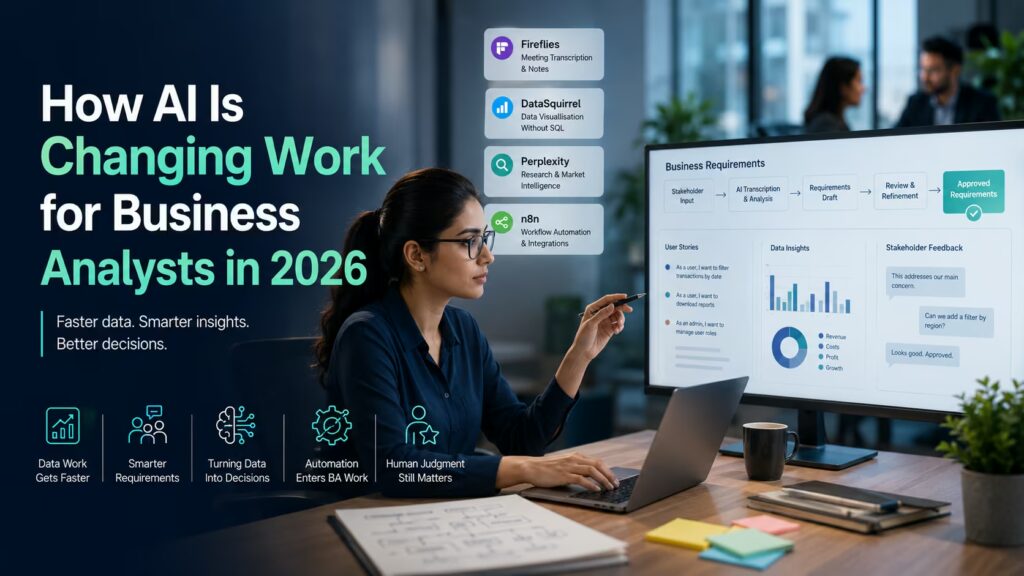
The most immediate shift is in data. Pulling reports, cleaning datasets, building basic visualisations, tasks that used to eat half a week now take a fraction of that. Tools like DataSquirrel let analysts create charts and summaries without needing to write SQL or wait on a data team. Perplexity speeds up market and competitor research significantly.
The result is more time for the actual analysis. Not the pulling and formatting, but the interpretation. What does this trend mean for this business? What decision does this data support? That part still requires a human.
Requirements Gathering Is Getting Smarter
One of the most time consuming parts of BA work is documenting requirements. Workshops, interviews, follow up calls, then turning all of that into structured user stories and functional specs. AI helps compress this significantly.
Fireflies transcribes stakeholder meetings automatically. What used to take an hour of note writing after a call now takes ten minutes of review and cleanup. The first draft of a requirements document can be generated from the transcript, then refined. The analyst is still doing the judgment work. The admin around it is largely gone.
Turning Data Into Decisions
Gathering data was never the hard part. The hard part is synthesising it into a recommendation a stakeholder can act on. AI helps get to a first draft of that synthesis faster, structuring scattered inputs into something coherent.
But the so what still belongs to the analyst. AI does not know the internal politics of the organisation, the constraint the product team is operating under, or why a technically correct recommendation will not land with this particular leadership team. That context is what makes a BA genuinely valuable and it cannot be automated.
Automation Is Entering BA Work Too
The more forward looking shift is analysts building their own lightweight automations. n8n workflows that pull data from multiple sources, generate weekly summary reports, or flag anomalies in a dataset without anyone having to check manually. Things that used to go on a developer’s backlog.
This is where the skill gap is opening up. Knowing how to identify what should be automated and then actually building it is becoming part of what a strong BA brings to the table. Programs like be10x’s AI Career Accelerator are where a lot of professionals are building this capability, specifically because the focus is on real workflow builds rather than theory.
What Does Not Change
Stakeholder management. Problem framing. The ability to walk into a room where three people disagree on what the problem is and leave with a shared definition. These are deeply human skills and they are becoming more valuable as the mechanical parts of BA work get compressed.
When everyone can generate a requirements document, the analyst who asks the right questions and earns stakeholder trust stands out more, not less.
What This Means for BAs Who Want to Stay Relevant
The analysts who thrive will use AI to move faster on the groundwork and spend the time saved on sharper thinking and better stakeholder conversations. The ones who resist it will spend their time on tasks that are increasingly commoditised.
The tool changes how fast you work. Your judgment is still what the business is paying for.
Frequently Asked Questions
How are business analysts using AI in 2026?
Mainly for data work, requirements documentation, and research. Transcription tools handle meeting notes, visualisation tools remove the need for SQL, and AI drafts first versions of specs and reports. This frees BAs to focus on interpretation, stakeholder management, and decision support.
Will AI replace business analysts?
It is changing the work rather than replacing the role. The mechanical parts of BA work are getting automated, but the judgment, problem framing, and stakeholder translation skills remain human. Strong BAs are becoming more productive while the value of genuine insight rises.
What tools are business analysts using with AI in 2026?
Fireflies for meeting transcription, DataSquirrel for data visualisation without coding, Perplexity for research, and n8n for building lightweight workflow automations. The skill is knowing how to combine them effectively.
What BA skills still matter in the age of AI?
Problem framing, stakeholder management, requirements clarity, and the ability to turn ambiguous inputs into actionable decisions. These become more differentiating as the admin and data work gets automated.
What is the biggest risk for BAs who over-rely on AI?
Losing the judgment that makes them valuable. If AI writes the requirements and generates the analysis, the BA stops developing the skill of knowing what questions to ask. Clients and stakeholders eventually notice when there is no real thinking behind the output.
