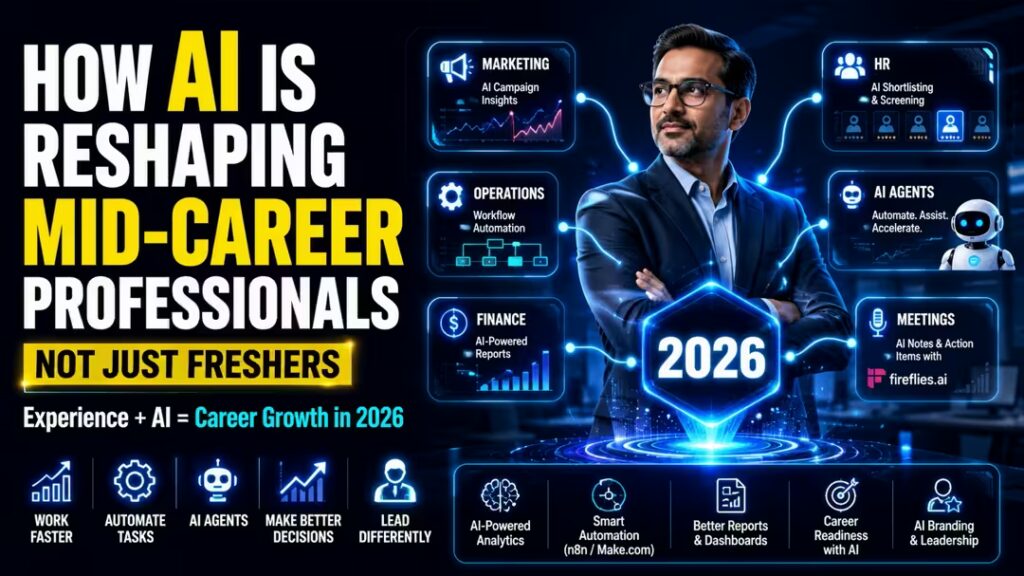
AI upskilling is not just for students and new graduates. Here is how mid-career professionals across marketing, operations, HR, and finance are using AI to stay relevant, move faster, and lead differently in 2026.
The Assumption That Needs to Go
Most conversations about AI careers start with freshers. Campus placements, internships, entry-level job descriptions — these are the stories that get shared. The assumption underneath all of it is that AI upskilling is a young person’s game. That if you have 7 or 12 or 15 years of experience, you have already figured out how to stay relevant.
That assumption is wrong.
In 2026, mid-career professionals are facing a very specific kind of pressure. Not the pressure of getting their first job. The pressure of staying valuable in roles they have held for years — while watching the nature of those roles change faster than any previous decade.
What Is Actually Changing for Mid-Career Professionals
The honest answer is: everything except the experience, and nothing except the tools.
A marketing manager with 10 years of experience still understands customer psychology, brand positioning, and stakeholder management better than any AI system. A finance professional with a decade in the field still brings judgment, context, and risk instinct that cannot be automated. That experience is not going anywhere.
What is changing is the layer on top of it.
Reporting that used to take three days now takes three hours — for people who know how to use AI-assisted analytics tools. Campaign briefs that required a full team to build now get drafted in a morning. Meeting notes, weekly summaries, performance decks — all of it moves faster for professionals who have learned to work with AI rather than around it.
This is the actual divide in 2026. Not experienced versus inexperienced. Not old versus young. It is professionals who have added AI as a working layer to their existing skills versus those who have not.
Why Mid-Career Professionals Face a Different Challenge Than Freshers
Freshers are entering the workforce with AI as a native part of how they work. They have no old habits to unlearn, no established workflows to rebuild, no years of doing things a certain way.
Mid-career professionals have all three.
The challenge is not learning AI from scratch. It is integrating AI into work that already exists, with processes that already run, with teams that already have expectations. That is genuinely harder. It requires a different kind of learning — not theory, not certification, but application inside real contexts.
Which is also why so many generic AI courses do not land for senior professionals. The content is built for people learning to work for the first time. It does not address what it actually takes to rebuild how a functioning professional operates.
What Mid-Career Upskilling With AI Actually Looks Like
It looks like a sales operations professional automating their weekly pipeline report using Make.com, cutting two hours of manual formatting every Monday. It looks like an HR manager using AI to shortlist resumes against a job description, not to replace judgment, but to exercise judgment on a better-filtered list. It looks like a content team lead using Fireflies to extract action items from every client call automatically, instead of losing half the call to note-taking.
None of these are entry-level skills. None of them are useful to someone who has never held these roles. They require domain expertise as the foundation — and AI as the multiplier on top.
The professionals getting ahead in 2026 are not the ones who know the most about AI in theory. They are the ones who have figured out exactly where AI plugs into their specific work, and built habits around that.
The Skills Mid-Career Professionals Need in 2026
AI-Assisted Workflows Understanding how to set up automation pipelines using tools like Make.com or n8n — not as an engineer, but as a professional who wants to eliminate the repetitive parts of their own job. This is increasingly a baseline expectation in operations, marketing, and project management roles.
Prompt Engineering for Professional Use Not prompt engineering as a standalone skill, but as a communication skill layered over existing expertise. A finance professional who can prompt an AI system to produce a variance analysis summary in their preferred format is not doing tech work. They are doing finance work faster.
AI-Powered Analytics Reading data, building basic visualisations, interpreting dashboards — these are no longer skills that belong only to data teams. Tools like DataSquirrel have made it possible for non-analysts to produce clean, accurate visual reports from raw data. Mid-career professionals who pick this up become significantly harder to sideline.
AI for Leadership and Branding At the senior end of the mid-career spectrum, the question shifts from productivity to positioning. How do you build authority in an industry where AI is producing content at scale? How do you make your voice distinct? This is a real strategic question for professionals who are five to ten years from leadership roles.
What the Be10x AI Career Accelerator Covers for Working Professionals
The AI Career Accelerator program is built around applied learning — modules grounded in real tools, real workflows, and real deliverables. For mid-career professionals specifically, the most relevant areas of the program are:
AI Fundamentals and Ecosystem Mastery — not a beginner’s introduction, but a structured map of the current AI landscape, so professionals can make informed decisions about what to learn and what to skip.
AI Product Building, Storytelling and Analytics — building actual outputs using AI, including dashboards, reports, and presentations. This module is where professionals with existing domain knowledge tend to move fastest, because they already know what good output looks like.
AI Agents and Autonomous Systems — covering n8n, workflow automation, and building AI employees that handle repetitive tasks. For operations and project management professionals, this is often the highest-impact module.
Career Readiness Using AI — repositioning yourself in the current job market, updating how you present your experience, and using AI tools to target and approach the right opportunities.
AI Branding and Leadership — for professionals who want to establish visible expertise in their field, not just use AI quietly in the background.
The program is designed to work alongside a full-time job, which matters significantly for mid-career professionals who cannot step out of their roles for months of full-time study.
The Real Question Mid-Career Professionals Are Asking
It is not “should I learn AI?” Most professionals past a certain experience level already know the answer to that.
The question is: “Will this actually change how I work, or will it be another certification I complete and forget?”
That depends entirely on whether the learning is tied to application. Reading about AI tools does not change workflows. Watching demonstrations does not build habits. What changes how a professional works is being forced to produce real output using AI — inside their actual domain, with real stakes.
That is the difference between AI education that moves careers and AI education that adds a line to a resume.
Frequently Asked Questions
Is AI upskilling relevant for professionals with 10+ years of experience?
Yes. In fact, experience makes AI upskilling more valuable — not less. AI tools amplify what you already know. A professional with deep domain expertise who adds AI workflows to their practice becomes significantly more productive and harder to replace than either the experienced professional without AI skills or the AI-savvy fresher without domain depth.
What AI skills are most useful for mid-career professionals in marketing, operations, or HR?
Workflow automation (Make.com, n8n), AI-assisted reporting and analytics, prompt engineering applied to domain-specific tasks, and AI-powered communication tools like Fireflies for meeting intelligence. The most useful skills are the ones closest to where you spend the most manual time.
How long does it take to meaningfully upskill in AI as a working professional?
With a structured program designed for working professionals, meaningful changes in daily workflow are typically visible within the first four to six weeks. Full integration across most professional functions takes three to six months of consistent applied learning.
Can mid-career professionals complete AI upskilling while working full-time?
Yes, provided the program is structured for that format. The be10x AI Career Accelerator is designed around live sessions, recorded access, and project-based learning that works within a full-time schedule.
Will AI make mid-career professionals obsolete?
The more accurate framing is that AI is making certain habits obsolete — not people. Professionals who continue doing manually what AI can do better and faster will face growing pressure. Professionals who redirect their time toward judgment, strategy, and relationship work — with AI handling the repeatable layer — are becoming more valuable, not less.

