
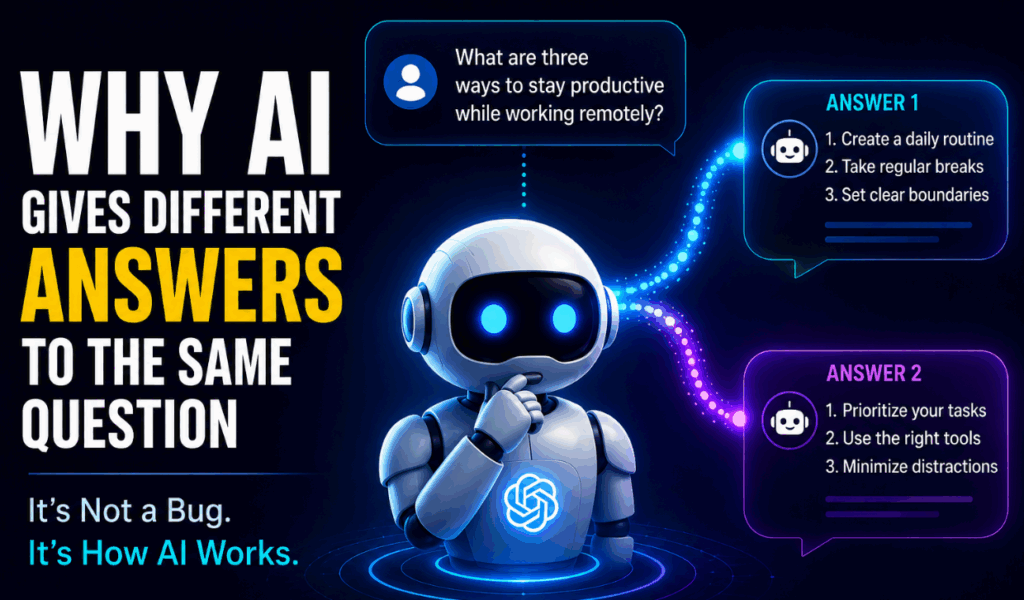
If you have ever asked an AI the same question twice and got two different answers, you were not imagining it. It is not a glitch. It is how these systems are designed to work.
Understanding why this happens changes how you use AI, how much you trust it, and how you build anything reliable with it.
AI is not a calculator
Most people approach AI with a calculator mindset. Same input, same output. That is how most software works. You run the same function with the same data and you get the same result every time.
AI language models do not work this way. When a model generates a response, it is not retrieving a stored answer. It is predicting what the next word should be, then the word after that, then the word after that, one token at a time. And that prediction process involves randomness by design.
The technical term for this is temperature. Temperature is a setting that controls how much variation the model introduces when choosing between possible next words. At higher temperatures, the model takes more risks, picks less obvious words, and produces more varied and creative output. At lower temperatures, it plays it safer and sticks closer to the most statistically likely option.
Most consumer AI products run at a moderate temperature by default. Which means the same prompt will almost never produce the exact same output twice.
Why randomness is a feature and not a bug
This surprises people because randomness sounds like a problem. If the model knows the right answer, why would it not just give you the right answer every time?
The reason is that for most tasks, there is no single right answer. If you ask AI to write a product description, draft an email, summarise a document, or brainstorm ideas, there are dozens of perfectly good responses. Randomness allows the model to explore that space rather than getting stuck producing the same output on repeat.
Without temperature, every user asking the same question would get identical responses. Creative tasks would feel robotic. Brainstorming would be useless. The model would feel more like a lookup table than a thinking tool.
Randomness is what makes AI feel generative rather than mechanical.
When this becomes a problem
The same property that makes AI useful for creative tasks creates real challenges when you need consistency.
If you are using AI to classify customer feedback, extract data from documents, or make decisions in an automated workflow, you need the same input to produce the same output reliably. A model that randomly varies its responses is not a stable foundation for that kind of work.
This is one of the most common gaps people discover when they move from experimenting with AI to actually building with it. Something that worked perfectly in testing produces slightly different outputs in production. Edge cases that never appeared during development start appearing at scale. The root cause is almost always the same. They did not account for non-determinism.
The fix is not to abandon AI for these tasks. It is to design around the variability. Lowering temperature settings, writing more constrained prompts, validating outputs before acting on them, and building in error handling are all standard approaches. But none of them are obvious until you understand why the problem exists in the first place.
What this means for how you use AI
For everyday use the practical implication is simple. Do not treat any single AI response as the definitive answer. If something matters, ask again. Compare responses. Notice where the model is consistent and where it varies, because that variation often tells you something useful about how confident the model actually is.
Tasks where the model gives you nearly identical answers twice are tasks it handles with high confidence. Tasks where the responses vary significantly are tasks worth reviewing more carefully before acting on.
For anyone building with AI, understanding temperature and non-determinism is foundational. It is the difference between a system that works reliably and one that works most of the time, which in production are very different things.
Be10x’s AI Career Accelerator covers LLM mechanics including how temperature, sampling, and prediction work under the hood, because the people who understand this layer build AI systems that hold up in the real world, not just in demos.
Frequently Asked Questions
Why does AI give different answers to the same question?
Because AI models use a process called temperature-based sampling when generating responses. Instead of always picking the single most likely next word, the model introduces controlled randomness. This means the same prompt can produce different outputs each time.
Can you make AI give the same answer every time?
Setting temperature to zero reduces variation significantly, but does not always guarantee identical outputs due to factors like floating point precision and hardware differences. For tasks requiring strict consistency, output validation and constrained prompting are more reliable approaches than relying on temperature alone.
Does variation in AI responses mean the answers are wrong?
Not necessarily. Variation often reflects the fact that multiple good answers exist. Where it becomes a concern is in automated workflows where consistency matters. In those cases the variation needs to be managed through system design rather than assumed away.
Is this the same across all AI models?
The underlying mechanism is similar across major language models, but different products expose temperature controls differently and set different defaults. Some consumer interfaces do not expose the setting at all, handling it invisibly in the background.
