
For a while I thought AI in marketing just meant faster copywriting. Type a prompt, get an ad headline, move on.
That’s such a small piece of it.
The actual time sink in marketing was never writing the copy. It’s everything wrapped around it. Pulling last week’s numbers into a deck. Checking what a competitor just launched. Following up with the forty leads that clicked but didn’t convert. Writing yet another report nobody reads past the first slide.
The marketers pulling ahead in 2026 aren’t the ones with the best prompts. They’re the ones who automated the parts of the job that used to eat their whole Friday.
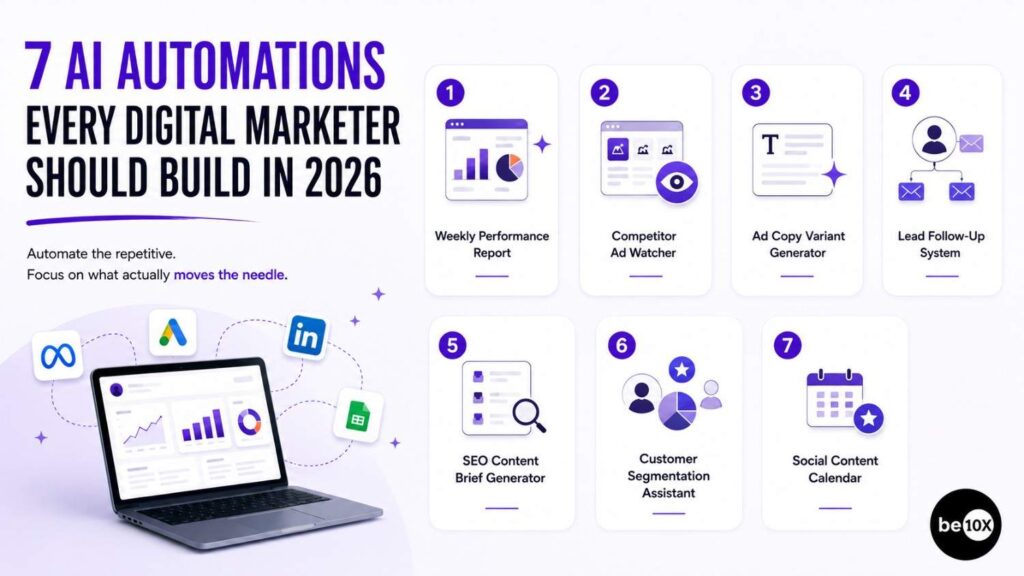
Here are seven worth building.
1. A Weekly Performance Report That Assembles Itself
The problem Every Monday, someone pulls numbers from four different ad platforms, drops them into a spreadsheet, and writes the same three paragraphs explaining what went up and what went down.
The fix Pull performance data automatically from your ad platforms and let AI draft the summary, the “why,” and the recommendation, before the meeting even starts.
Rough workflow Data gets pulled from Meta, Google, and LinkedIn ads on a schedule. AI compares this week to last, flags the biggest movers, and drafts two or three lines explaining likely causes. You review, adjust, send.
Why it’s worth it The reporting itself was never the valuable part. The decision that comes after it is. This just gets you there faster.
2. A Competitor Ad Watcher
The problem Competitors change their offers, creative, and messaging constantly, and finding out usually happens by accident, scrolling your own feed.
The fix An assistant that checks competitor ad libraries on a schedule and flags anything genuinely new, not just cosmetic tweaks.
Rough workflow Ad library data gets pulled for a tracked list of competitors. AI compares against what was live last week and surfaces only meaningful changes, a new offer, a new angle, a creative style shift.
Why it’s worth it You stop finding out about a competitor’s move three weeks after everyone else already reacted to it.
3. An Ad Copy Variant Generator That Actually Knows What Worked
The problem Writing fresh ad copy variants for testing is fine the first few times. By the twentieth campaign, it starts feeling like writing the same five headlines with different words.
The fix Feed AI your top-performing past copy and let it generate new variants based on what’s actually converted, not just generic templates.
Rough workflow Historical performance data plus winning copy goes in. AI generates variants that follow the patterns of what worked, different angle, same underlying hook. You pick the best three to actually test.
Why it’s worth it Testing gets faster, and the variants going into testing are already grounded in what your audience responds to instead of a guess.
4. A Lead Follow-Up System That Doesn’t Forget Anyone
The problem Someone clicks an ad, fills a form, and then… sometimes gets a follow-up in two days, sometimes never, depending on how busy the sales team is that week.
The fix An automated sequence that qualifies the lead based on their behavior and triggers the right follow-up without waiting on a person to remember.
Rough workflow Lead comes in, gets scored based on source, behavior, and form data. High-intent leads get a same-day personalized follow-up drafted automatically. Lower-intent leads go into a nurture sequence instead of falling through entirely.
Why it’s worth it The leads that got away were rarely bad leads. Most of the time they just got followed up with too late, or not at all.
5. An SEO Content Brief Generator
The problem Before a writer can even start an article, someone has to research the keyword, check what’s already ranking, and figure out the gaps. That research often takes longer than writing the piece.
The fix An assistant that pulls the top-ranking pages for a target keyword and drafts a brief: structure, subtopics competitors are covering, questions people are actually asking.
Rough workflow Keyword goes in. AI pulls and analyzes the current top results, extracts common structure and gaps, and returns a brief a writer can start from immediately instead of starting from a blank doc.
Why it’s worth it The research bottleneck disappears. Writers spend their time writing instead of researching what to write.
6. A Customer Segmentation Assistant
The problem Everyone knows segmentation matters. Almost nobody actually keeps their segments updated, because manually re-running that analysis every month gets skipped when things get busy.
The fix An assistant that re-segments your audience automatically based on updated behavior data, so your targeting doesn’t quietly go stale.
Rough workflow Customer data updates continuously. AI re-clusters based on recent behavior, purchase patterns, and engagement, and flags any segment that shifted meaningfully since last month.
Why it’s worth it Stale segments are one of the quietest reasons campaigns underperform. Nobody notices until conversion rates have already been sliding for weeks.
7. A Social Content Calendar That Plans Around What’s Actually Working
The problem Planning a month of social content usually means starting from a blank calendar and hoping this batch performs as well as the last one.
The fix An assistant that looks at what’s actually performed well recently and drafts the next month’s calendar leaning into those patterns, instead of starting cold every time.
Rough workflow Past post performance gets analyzed for format, timing, and topic. AI drafts a calendar of post ideas and suggested timing based on what’s been working, and you fill in the creative from there.
Why it’s worth it Content planning stops being a guessing game and starts being a pattern you can actually build on.
The Bigger Shift
Every time this comes up, someone asks if AI is going to replace marketers.
Wrong question, honestly. The better one is: which parts of this job should have stopped being manual a long time ago?
Most of a marketer’s week was never spent on the genuinely creative decisions. It was spent compiling reports, chasing competitors, and following up on leads that were already interested. That’s exactly the part AI is good at taking off your plate.
Building this kind of automation usually starts with rough, self-built versions. be10x’s AI Career Accelerator offers a dedicated module that sharpens the process, replacing what would otherwise be pure trial and error.
None of it needs a big budget. An API key, a spreadsheet, and a free afternoon is usually enough for a first version.
