
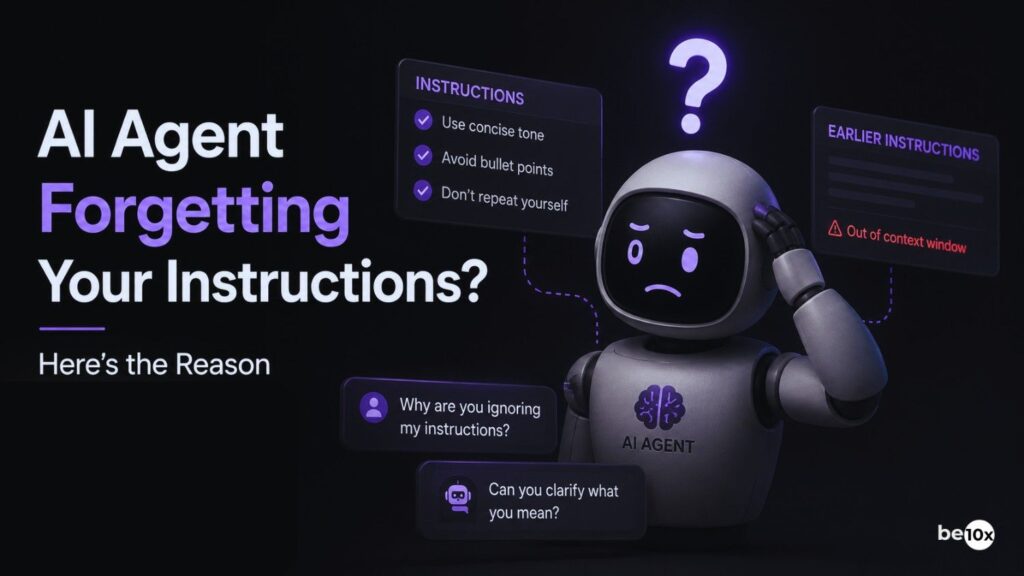
It happens to almost everyone eventually. Someone sets up an assistant or agent, gives it clear instructions at the start, works with it for a while, and then watches it slowly drift, contradicting an earlier rule, asking for something it was already told, or rewriting work in a style it was explicitly asked to avoid. It looks like the system is getting worse over time. It isn’t. It’s doing exactly what it was built to do, and understanding why changes how a person works with these tools entirely.
The model isn’t remembering the conversation. It’s re-reading it.
The first thing worth unlearning is the idea that an AI holds a conversation in its head the way a person does. It doesn’t. Every single time it responds, it reads back through the entire conversation from the beginning, treats that text as its input, and generates the next reply. There is no separate memory bank where earlier instructions quietly live on. The “memory” of a chat is just the transcript being fed back in, over and over, on every turn. That distinction sounds academic until it starts explaining the exact failures behind an AI agent forgetting things mid-task.
There’s a hard limit on how much it can read at once
Everything the model reads on a given turn has to fit inside a fixed space called the context window. That space holds the setup instructions, the full back-and-forth so far, any documents that were pasted in, and the request being made right now. It’s finite. When a conversation or a task grows long enough that all of it can no longer fit, something has to give, and what gives is usually the oldest material, the instructions from the very start that have since been pushed out to make room. The reason this connects directly to cost is that every turn re-processes all of that text, which is why a long conversation quietly gets more expensive as it goes; Be10X breaks down that mechanic in its explainer on how every word you type costs money.
Why an AI agent forgetting things always seems to start later, not sooner
The pattern is predictable once the cause is clear. Early in a task, everything fits, so the agent behaves. Later, as the transcript swells with back-and-forth, uploaded files, and generated output, the earliest instructions are the first to fall off the edge of what the model can still see. From the outside it looks like the agent forgot. In reality the instruction is simply no longer in front of it. The model can only act on what’s currently inside the window, and the founding rules of the task are often the very things sitting furthest from the present moment.
An AI agent forgetting instructions feels sharper than a chatbot losing the thread
A quick question-and-answer exchange rarely runs long enough to hit the limit. Agents are different, because they’re built to carry out multi-step tasks that plan, use tools, and loop through work over an extended run, which means their transcripts balloon fast. That extended, self-directed way of working is exactly what separates an agent from a one-off request, a distinction Be10X lays out in its piece on the real difference between an LLM call and an AI agent. The more autonomous and long-running the agent, the more its memory problem stops being a quirk and becomes the central design challenge.
What actually fixes it isn’t a better memory. It’s better handling of what stays in view.
Once the cause is clear, the solutions stop feeling like magic and start feeling like housekeeping. Restating the critical instructions periodically keeps them inside the window instead of trusting them to survive from the start. Summarizing a long exchange and continuing from the summary preserves the important decisions while shedding the bulk, a technique AI labs themselves rely on and document in guidance on effective context engineering for agents. Keeping the standing rules short, specific, and near the current request means they hold their place rather than getting buried. Breaking a sprawling task into smaller, self-contained runs stops any single transcript from outgrowing the space it has. None of these add real memory. They all do the same underlying thing: make sure the things that matter are still on the desk when the model looks down at it.
The mental shift that stops an AI agent forgetting your instructions
The people who get consistent results from agents aren’t the ones who found a tool with a better memory. They’re the ones who stopped assuming memory existed at all and started managing what the model can see at any given moment. Treating the context window as a small, crowded workspace, rather than an infinite mind that remembers everything, is the difference between an AI agent forgetting its task halfway through and one that holds its shape across a long, complicated job.
This kind of practical, under-the-hood understanding is exactly what the AI Agents track of the AI Career Accelerator Program at be10x is built around, not just wiring an agent together, but knowing why it behaves the way it does so it holds up on real work rather than falling apart halfway through.
