
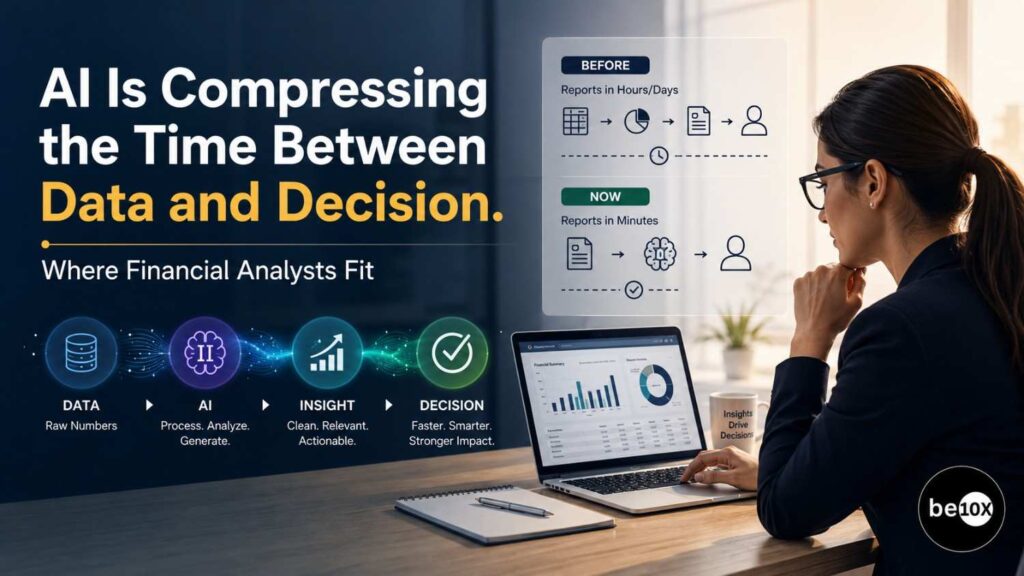
There used to be a clear gap between when data arrived and when a decision got made. A financial analyst would pull numbers, clean them, build a model, write commentary, and hand it off. That gap is where the job lived. It is also the part that AI has started to close.
Reports that once took a full day to assemble now take an hour. Variance analysis that needed a template and a checklist can be generated, checked, and reformatted before lunch. The work itself has not disappeared. What has changed is how much of it is manual versus directed.
The Shift From Building to Directing
Most financial analysts are trained to build: build the spreadsheet, build the pivot table, build the forecast. AI tools are good at building too, often faster and with fewer errors on the mechanical parts. The skill that is becoming more valuable is knowing what to ask for, how to check the output, and where a model is likely to be wrong.
This is not a small shift. An analyst who can direct AI to generate a first-pass cash flow model, then spend their time stress-testing assumptions and catching what the model missed, is doing a different job than one still building the model line by line. Both know finance. Only one of them is working at the speed companies now expect.
Where the Risk Actually Sits
The risk for financial analysts is not that AI replaces judgment. Judgment about risk, about which assumptions matter, about what a client or CFO actually needs to hear, that part is still human. The risk is spending years building surface-level fluency with AI tools without ever using them on something that mattered under pressure. A lot of professionals can describe what a large language model does. Far fewer have used one to compress a real deliverable and then had to defend the output to someone senior.
That gap between describing AI and having used it on a real task is where hiring decisions are starting to happen. Job postings for analyst roles are increasingly listing AI-assisted reporting and automation-aware workflows as expected, not optional.
What Closing the Gap Looks Like in Practice
Cohorts like be10x’s AI Career Accelerator have started building this directly into structured learning paths for working professionals, including analysts and other finance roles, precisely because reading about AI and using it under a deadline are not the same skill. The programs that seem to actually change outcomes are the ones that force a real deliverable, not just a demo.
For financial analysts specifically, that usually means practicing with real datasets, real reporting formats, and the kind of ambiguous requests a manager actually sends, not clean sample data designed to make a tool look good.
The Practical Takeaway
The gap between data and decision is not going to widen back out. It is going to keep compressing. Financial analysts who spend time now getting comfortable directing AI on real reporting work, not just reading about it, are the ones who will still be relevant when that compression finishes playing out across the industry. The ones who wait for their company to mandate it will be catching up instead of setting the pace.
