
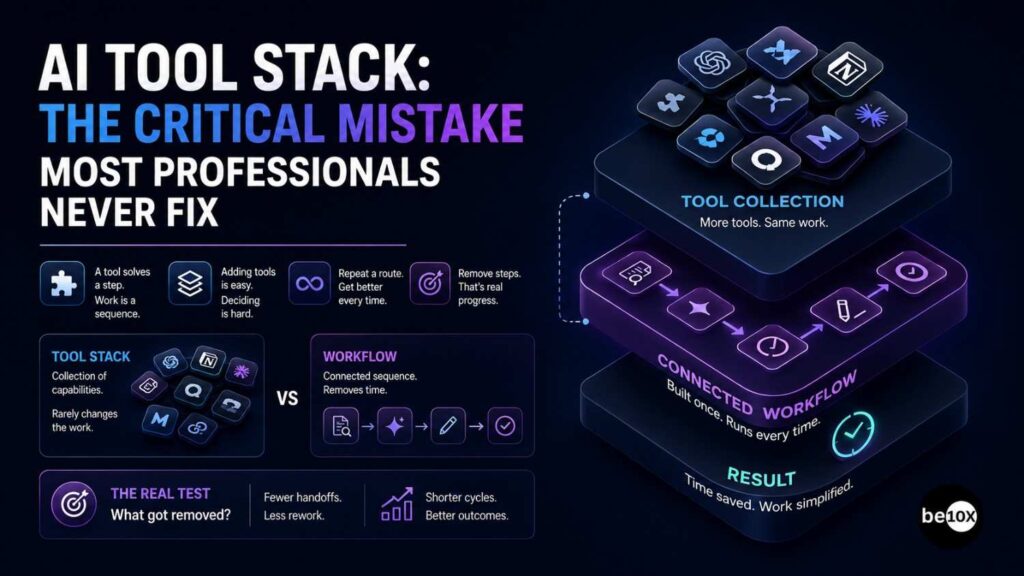
AI tool stacks keep expanding while the work they were supposed to change stays exactly the same shape. Somebody adds the fifty tools from the list, then the hundred tools from the next list, and ends up with a browser full of logins and a job that still runs the way it always ran. Collecting is satisfying because it is visible and instant. A single sequence that removes two hours from a week is neither, which is why almost nobody builds one.
The feature on why execution capability is becoming the new career currency frames the gap usefully, arguing that the professional advantage is shifting toward people who can automate a repetitive process and compress a decision rather than people who can name the most software. McKinsey’s research on generative AI points in the same direction, finding that a large majority of organisations report using it somewhere while only a small minority have scaled it into how work actually gets done. The same pattern shows up one person at a time.
A tool solves a step, and work is not made of single steps
An AI tool stack is a collection of capabilities. A job is a sequence: information arrives, somebody interprets it, somebody produces something, somebody checks it, somebody sends it. A tool that handles the third of those five steps brilliantly leaves the other four untouched, and the person still carries the whole chain in their head. This is why a stack can grow for months without a single process getting shorter. Nothing was connected to anything.
The stack grows because adding is easier than deciding
Signing up takes a minute and feels productive. Deciding which of forty tools deserves a permanent place in a working week takes judgement, because it means admitting most of them do not. So the AI tool stack accumulates by default, each new addition justified by a demo that looked impressive rather than by a task that was genuinely expensive. Nobody audits a subscription list the way they audit a spreadsheet, and the cost stays invisible.
Two people with an identical AI tool stack produce different work
Give two professionals the same four subscriptions and the outputs will not match, sometimes by an enormous margin. One opens whichever tool feels relevant that morning, starts from a blank prompt, and gets a different quality of answer every time. The other has a fixed route: research goes to one place, documents go to another, the draft always starts from the same brief structure. The second person is not more talented and is not using a better AI tool stack. They are repeating something, and repetition is what allows a process to improve.
Coverage is not the same as depth
Knowing what twenty tools do is general knowledge. Knowing exactly how two of them behave on the specific work someone does every week is a skill, and only the second one shows up in output. be10X’s look at the career path behind the AI generalist label reaches the same conclusion from the hiring side, observing that the professionals who stall are the ones who collect every new tool that appears instead of going deep on the two or three that touch the day job.
The question an AI tool stack cannot answer
The useful question is not which AI tool stack is best. It is which task in the week costs the most, and whether that cost sits in producing the work or in the shuffling around it. be10X’s breakdown of why some teams never get faster after adoption is direct about the failure mode, describing teams that kept every existing task and simply inserted an AI draft step in front of each one, turning one step into two and calling it progress.
What a working AI tool stack usually looks like
The stacks that hold up are unglamorous and small. One assistant for research and analysis, something built for working across a pile of source documents, something purpose-built for whichever craft the person actually practises, and one place where output gets assembled. Frequently the most load-bearing item in a working AI tool stack is not an AI tool at all: a saved brief, a checklist, a template that makes the input consistent. The tool improves when the instruction to it stops changing.
Where a wide AI tool stack genuinely earns its keep
There is an honest exception. People whose job includes evaluating tools, and anybody working in a category that moves quickly, need to keep sampling, because a stack that stopped changing three years ago is its own kind of problem. Breadth is a real asset there. The distinction is between sampling deliberately and accumulating passively, and between a stack that gets pruned and one that only grows.
The test that settles it
There is one question that separates an AI tool stack from a workflow, and it is what got removed. Somebody with a workflow can name a step that no longer exists: a report nobody assembles, a formatting job that stopped happening, a message that writes itself from a template. Somebody with a collection can only name tools. The first answer is worth a salary conversation and the second one is a browsing habit.
Anyone weighing up the best AI course for closing that gap should judge it on whether the programme ends with a process that changed or a tour of software. The workflow and automation modules in be10X’s AI Career Accelerator Program are structured around scoping one real task and shipping it end to end, on the view that a professional who has removed a step once knows how to find the next one. Register now.

