
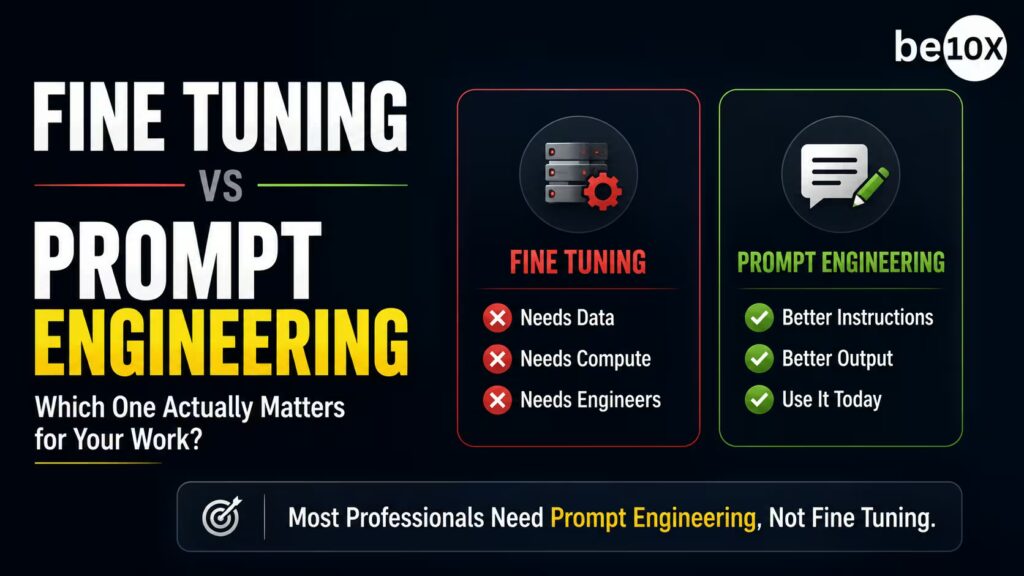
There are two terms that come up repeatedly when professionals start going deeper into AI. Fine tuning and prompt engineering. Both sound important. Both get written about extensively. And most people trying to figure out which one to learn have no clear sense of what either of them actually means for the work they do every day.
The short answer is this. For most professionals, one of these matters enormously and the other is almost entirely irrelevant to their day to day work. Understanding which is which saves a significant amount of time spent learning the wrong thing.
What fine tuning actually is
Fine tuning is the process of taking an existing AI model and training it further on a specific dataset so that it behaves differently from its default state. A company might fine tune a model on years of their own customer support conversations so it responds in a way that matches their tone and understands their specific products. A legal firm might fine tune a model on thousands of legal documents so it handles legal language more accurately.
This requires data. A lot of it, and good quality data. It requires compute resources, which means real infrastructure costs. It requires technical expertise to run the process correctly. And it requires time, often weeks, before the results can be evaluated properly.
Fine tuning is what engineering teams at large organisations do when they have a very specific, repeatable use case that a general model does not handle well enough out of the box. It is not something an individual professional does. It is not something most companies even need.
What prompt engineering actually is
Prompt engineering is the skill of giving an AI model better instructions so it produces better output. No training required. No data required. No technical infrastructure. Just clearer, more specific, more contextual input.
The same model that produces a generic unusable response to a vague instruction will produce a highly specific, usable response to a well-constructed one. The model did not change. The instruction did. That gap, between a vague prompt and a precise one, is where prompt engineering lives.
A marketing professional who knows how to construct a prompt that includes the audience, the tone, the goal, the constraints, and an example of what good looks like will consistently get better output than one who types a single sentence and hopes for the best. An operations professional who knows how to give an AI agent clear, structured instructions will build workflows that actually run versus ones that fail halfway through.
This is not a technical skill. It is a communication skill applied to a new kind of tool.
Why people get confused between the two
The confusion happens because both terms get used in AI conversations as if they exist on the same level of relevance for the average professional. They do not.
Fine tuning gets attention because it sounds powerful and technically sophisticated. It is the thing large AI labs do. It is the thing that gets written about in research papers. It carries a weight that prompt engineering does not, simply because it sounds harder.
But hard is not the same as relevant. For a sales professional trying to get better outreach emails, a finance professional trying to produce faster reports, or an HR manager trying to shortlist candidates more efficiently, fine tuning is a solution to a problem they do not have. Prompt engineering is a solution to the problem they face every single day.
Where each one actually belongs
Fine tuning belongs in the hands of engineering teams at organisations with specific, high volume, repeatable AI use cases that general models cannot handle adequately. It belongs in companies building AI products, not in companies using AI tools.
Prompt engineering belongs with every professional who uses AI in any part of their work. Which in 2026 is most professionals, whether they realise it or not.
The professional who understands how to construct a clear, contextual, specific prompt is getting meaningfully better output from the same tools everyone else has access to. That advantage compounds over time. Better prompts produce better outputs, which build better habits, which produce even better prompts.
What this means for how you spend your learning time
If you are a working professional trying to get more out of AI, the answer is clear. Prompt engineering is the skill that will change your daily output. Fine tuning is knowledge worth having at a conceptual level so you understand what it is when you encounter it, but it is not where your learning time should go.
The Be10x AI Career Accelerator is built around this distinction. Prompt engineering is treated as a core applied skill, not a theoretical concept, because it is the one that actually changes how professionals work inside real workflows. Fine tuning gets covered so professionals understand the landscape. But the focus stays on what actually moves the needle.
Frequently Asked Questions
What is the difference between fine tuning and prompt engineering?
Fine tuning retrains an AI model on specific data to change how it behaves fundamentally. Prompt engineering gives a model better instructions to get better output without changing the model itself. One requires technical infrastructure and expertise. The other requires clarity of thought and practice.
Do I need to know how to fine tune a model to use AI effectively at work?
No. For the vast majority of professionals, prompt engineering is the only skill that directly affects the quality of their daily AI output. Fine tuning is something engineering teams do, not individual professionals.
Is prompt engineering a technical skill?
No. It is a communication skill. It requires being specific about context, audience, constraints, and what a good output looks like. Anyone who can write a clear brief can learn to write a clear prompt.
Who actually needs fine tuning?
Organisations building AI products, companies with very specific high volume use cases that general models do not handle well, and engineering teams with the infrastructure and expertise to run the process. Not individual professionals using AI tools in their day to day work.
Where can I learn prompt engineering as a practical skill?
Programs like the Be10x AI Career Accelerator cover prompt engineering as an applied skill inside real professional workflows, not as a standalone concept. The focus is on using it to produce real output across marketing, operations, finance, and other professional functions.
