
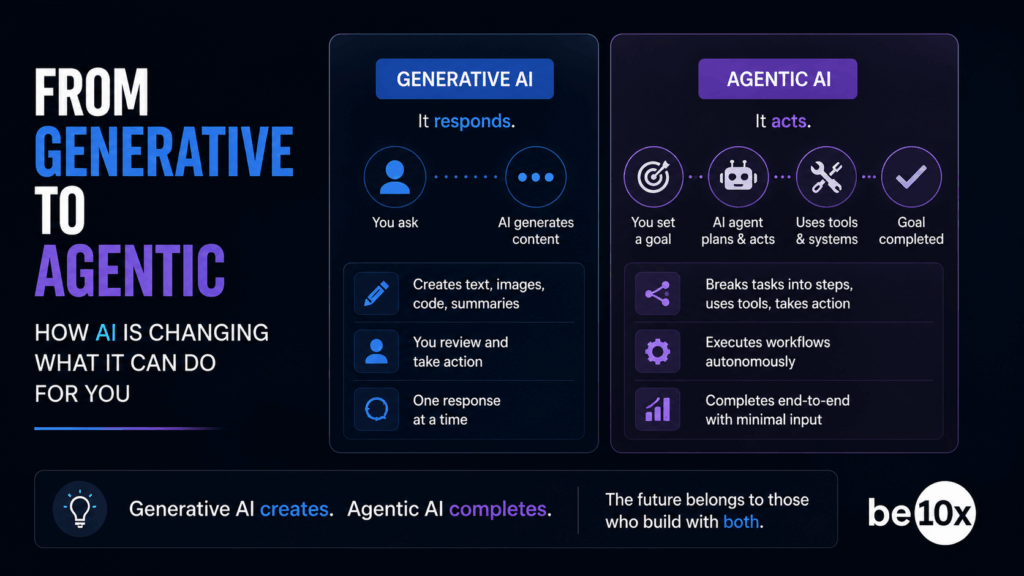
There is a version of AI most people are familiar with. You type something, it responds. You ask for a draft, it writes one. You ask for a summary, it summarises. You ask a question, it answers.
This is generative AI. And it is genuinely useful. But it is also only the beginning of what AI is becoming capable of doing.
In 2026, the conversation has shifted. Not because generative AI stopped being useful, but because a new category has emerged that does something fundamentally different. Agentic AI does not just generate. It acts.
Understanding the difference between these two is becoming one of the more important things a working professional can get clear on, because the gap between them is not small, and confusing one for the other leads to significantly underestimating what is actually possible.
What generative AI actually does
Generative AI creates. Given a prompt, it produces an output. Text, images, code, summaries, translations. The model takes your input, processes it, and generates something new based on patterns it learned during training.
This is what ChatGPT does when it writes an email for you. It is what Claude does when it summarises a long document. It is what Midjourney does when it produces an image from a description.
The key characteristic of generative AI is that it responds. You initiate, it produces, and then the interaction is complete. What happens with the output is entirely up to you. The model does not take the email it just wrote and send it. It does not take the summary it produced and update the relevant document. It generates and stops.
This is not a limitation in the negative sense. Generative AI has changed how millions of professionals work. The ability to produce a high quality first draft in seconds, to summarise an hour long meeting in two minutes, to generate ten variations of a piece of copy instantly, is genuinely valuable. But it is one layer of what AI can now do.
What changed to make agentic AI possible
The shift happened when AI models got connected to the real world.
Generative AI operates inside a conversation. Agentic AI operates inside systems. When a language model was given the ability to use tools, to search the web, read files, call APIs, update databases, send emails, and trigger external workflows, the nature of what it could do changed completely.
It was no longer just producing text. It was producing action.
An AI agent can be given a goal rather than a prompt. Instead of “write an outreach email for this lead,” an agent can be given “research this company, identify the most relevant service we offer them, write a personalised outreach email, and log the interaction in the CRM.” The agent reasons about what needs to happen, decides which tools to use at each step, executes those steps in sequence, handles anything that goes wrong, and completes the task without requiring a human to manage each stage.
That is a fundamentally different kind of capability. Not smarter in the traditional sense. More autonomous.
Where generative AI ends and agentic AI begins
The clearest way to understand the distinction is to look at where human involvement is required.
Generative AI requires a human at every step. You prompt, it generates, you take the output and do something with it, you prompt again. The human is the bridge between each interaction and the next action.
Agentic AI requires a human at the goal level, not the task level. You define what you want to achieve. The agent figures out how to achieve it, executes the steps, and reports back when the goal is complete or when it encounters something it cannot resolve on its own.
This does not mean agentic AI replaces human judgment. The best implementations keep humans involved at decision points that require real judgment, strategy, or accountability. What agents handle is the execution layer, the steps between decisions that are repetitive, rule-based, or time-consuming.
What this means in practice for professionals
A marketing professional using generative AI asks it to write a campaign brief. A marketing professional using agentic AI sets up an agent that monitors campaign performance, identifies underperforming segments, drafts revised copy for those segments, and flags it for human review before anything goes live.
An operations professional using generative AI asks it to summarise a process document. An operations professional using agentic AI builds a workflow where the agent monitors incoming requests, categorises them, routes them to the right team, sends acknowledgment messages, and updates the tracking sheet automatically.
A sales professional using generative AI asks it to draft an outreach email. A sales professional using agentic AI builds a system that researches each prospect, generates a personalised email based on their specific situation, and prepares the entire outreach sequence without manual input for each lead.
In each case the underlying AI capability is similar. What changes is the layer of autonomy built around it, and the amount of human time that layer frees up.
Where AI is going next
The next development already underway is multi-agent systems. Instead of one AI agent handling an entire workflow, multiple specialised agents work together. One agent handles research, one handles writing, one handles scheduling, one handles tracking. They coordinate with each other, pass information between themselves, and complete complex workflows that no single agent could handle efficiently alone.
This is not science fiction. It is already being built and deployed in organisations that are serious about extracting full value from AI. The professionals and teams that understand how these systems work, and where they fit in real workflows, are the ones building the infrastructure that others will eventually catch up to.
Why understanding both matters now
Most professionals in 2026 are somewhere in the generative AI phase. They are using AI to create, to draft, to summarise. That is valuable and worth doing well.
But the professionals getting ahead are starting to understand agentic AI. Not just conceptually, but practically. Where does an agent make sense in my workflow. What tasks are repetitive enough and rule-based enough to hand off. What judgment points should stay human. These are the questions that separate AI users from AI practitioners.
The Be10x AI Career Accelerator covers both layers. Generative AI as a foundation, used well across real professional tasks. Agentic AI as the next layer, built practically using tools like n8n, with real workflows and real outputs. Because understanding the evolution from generative to agentic is not just interesting context. It is the map of where professional AI skills are heading.
Frequently Asked Questions
What is the difference between generative AI and agentic AI?
Generative AI creates content in response to prompts. Agentic AI takes action toward goals, using tools, making decisions across multiple steps, and completing tasks without human involvement at each stage. Generative AI responds. Agentic AI acts.
Do I need to understand both generative and agentic AI as a professional?
Yes. Generative AI is already part of most professional workflows. Agentic AI is becoming part of them. Understanding both helps professionals make better decisions about where to use each, and what to expect from each.
Is agentic AI available to use today or is it still emerging?
It is available today. Tools like n8n, Make.com, and various AI agent frameworks allow professionals and teams to build agentic workflows without deep technical expertise. The infrastructure exists. The skill gap is in knowing how to use it effectively.
What kinds of tasks are best suited for AI agents?
Tasks that are repetitive, rule-based, involve multiple steps in a fixed sequence, and do not require human judgment at every stage. Outreach workflows, reporting pipelines, data processing, scheduling, and follow up sequences are common examples.
