
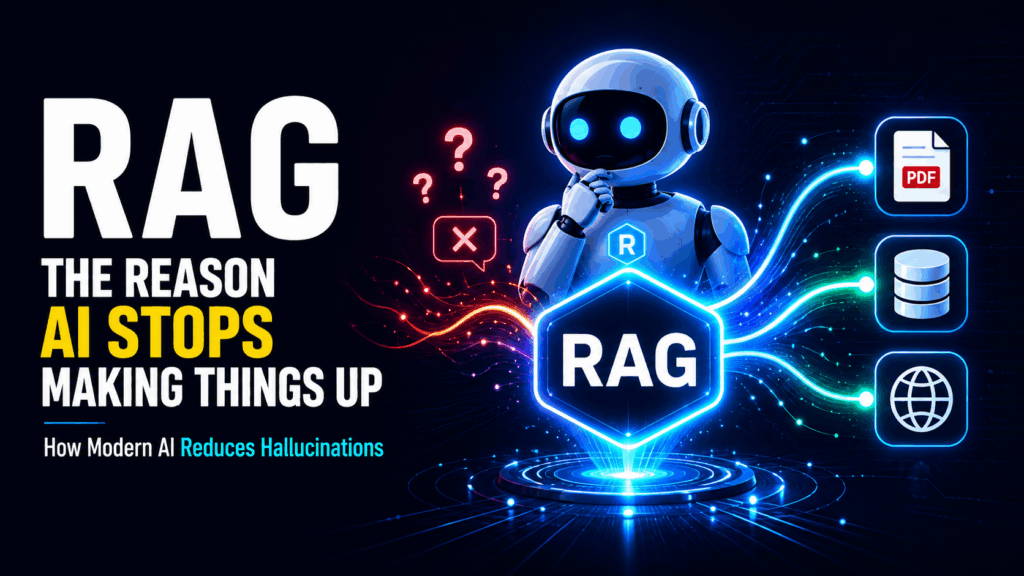
Hallucinations are not a bug you can patch. They are a feature of how language models work. RAG is the architectural solution that most production AI systems rely on in 2026.
RAG stands for Retrieval Augmented Generation. It is a technique where an AI model is given relevant information retrieved from an external source before generating a response, rather than relying solely on what it learned during training. This reduces hallucinations by giving the model accurate, current context to work from. In 2026, RAG is the standard approach for building AI systems that need to answer questions about specific documents, databases, or knowledge bases accurately.
Why AI makes things up in the first place
A language model does not look things up. It generates text based on patterns learned from a vast amount of training data. When you ask it a question, it produces the most statistically plausible response given everything it has seen. Most of the time this works well. When it does not have accurate information about something specific, it produces text that sounds plausible but may be wrong.
This is what a hallucination is. Not a random error. A confident, fluent, well-formatted response that happens to be factually incorrect. The model does not know it is wrong because it is not retrieving facts from a database and checking them. It is generating text that fits the pattern of a correct answer.
This matters most in applications where accuracy is essential. A customer support agent that gives wrong answers about a product. A legal research tool that cites cases that do not exist. A healthcare assistant that provides inaccurate medical information. In all of these, the model’s tendency to generate plausible-sounding text rather than verified facts is a serious problem.
What RAG does differently
RAG changes the flow in a fundamental way. Instead of asking the model to answer from memory, you first retrieve relevant information from a trusted source, then give that information to the model along with the question, then ask it to answer based on what it was just given.
The model is no longer guessing. It has the relevant facts in front of it and is being asked to synthesise and present them clearly. This is similar to the difference between asking someone to answer a question from memory and asking them to answer it with the relevant documents open in front of them. Both approaches can produce an answer. The second is far more reliable for factual accuracy.
The retrieval step uses embeddings to find the most relevant sections of your documents for a given query. This is why understanding embeddings, covered in our previous post, is foundational to understanding RAG. The quality of retrieval determines the quality of what the model has to work with, which in turn determines the quality of the final answer.
How RAG works in practice
Building a RAG system involves three components working together. First, your documents are processed and converted into embeddings, then stored in a vector database like Pinecone. This happens once when you set up the system.
Second, when a user asks a question, the question is also converted into an embedding. The vector database finds the stored document sections whose embeddings are most similar to the question embedding. These are the sections most likely to contain the relevant information.
Third, those retrieved sections are passed to the language model along with the original question. The model is instructed to answer based on the provided context. The answer is grounded in your actual documents rather than in the model’s training data.
The result is an AI system that can accurately answer questions about your specific documents, your company’s policies, your product specifications, or any other knowledge base you provide, without hallucinating information that was never there.
Where RAG is being used in 2026
Customer support is the most common deployment. A RAG system trained on product documentation, FAQs, and support articles can answer the majority of customer queries accurately and consistently. When it cannot find relevant information in the knowledge base, it can be designed to escalate to a human rather than guess.
Internal knowledge management is growing quickly. Large organisations contain enormous amounts of information in documents, wikis, and databases that employees rarely surface effectively. A RAG system over internal documentation means employees can ask questions in natural language and get accurate answers sourced from verified internal content.
Legal and compliance applications are emerging. Firms are building RAG systems over case law, regulations, and internal policies that can answer specific questions with citations to the source documents, reducing the time lawyers and compliance professionals spend on initial research.
The limitations RAG does not solve
RAG significantly reduces hallucinations but does not eliminate them. If the relevant information is not in the knowledge base, the model may still hallucinate rather than say it does not know. Designing the system to acknowledge uncertainty rather than guess is an important part of any RAG implementation.
Retrieval quality matters enormously. If the embedding step does not surface the right documents for a given query, the model gets wrong context and produces wrong answers. Poor document quality, inconsistent terminology, and overly large chunks all degrade retrieval. A RAG system is only as good as its retrieval step.
Keeping the knowledge base current requires ongoing effort. A RAG system trained on documents from six months ago will give accurate answers about that period but will not know about anything that has changed since. For fast-moving domains, the maintenance burden of keeping documents current is real.
What Be10x teaches about RAG
The agents and automation curriculum at Be10x’s AI Career Accelerator includes a session specifically on building a customer support agent using RAG, with Pinecone as the vector database and OpenAI for generation. Learners build an end-to-end RAG system, which means encountering all of the real challenges, chunking documents correctly, handling retrieval failures, and designing for cases where the knowledge base does not have the answer.
Understanding RAG as a concept is useful. Building one and seeing where it breaks is how the understanding becomes practical. That gap between knowing what RAG is and knowing how to make it work reliably is what the hands-on module is designed to close.
Frequently Asked Questions
What does RAG stand for?
RAG stands for Retrieval Augmented Generation. It is a technique that combines information retrieval with language model generation to produce accurate, grounded responses based on specific documents or knowledge bases rather than relying solely on the model’s training data.
How does RAG reduce hallucinations?
RAG reduces hallucinations by giving the model verified, relevant information before asking it to generate a response. Instead of generating from memory, the model synthesises information it has just been given. This grounds the output in actual source material rather than statistical pattern matching from training.
What is a vector database and why is it used in RAG?
A vector database stores document embeddings, numerical representations of text meaning, in a format that can be searched efficiently by similarity. In a RAG system, the vector database is where your documents live after they have been converted to embeddings. When a query arrives, the vector database finds the most semantically similar document sections to retrieve as context.
Does RAG completely eliminate hallucinations?
No. RAG significantly reduces hallucinations by grounding responses in retrieved documents, but if the relevant information is not in the knowledge base, the model may still generate inaccurate content. Well-designed RAG systems include fallback behaviours, such as acknowledging when information is not available, rather than allowing the model to guess.
Where can I learn to build a RAG system?
Be10x’s AI Career Accelerator includes a hands-on session on building a customer support agent using RAG with Pinecone and OpenAI. The session covers end-to-end RAG implementation including document processing, retrieval configuration, and handling edge cases where retrieval fails.
