
AI concepts sit unexamined underneath every tool you use. Most people who use them daily have never needed to know what happens inside. You type a question, wait two seconds, a paragraph appears.
Then something odd happens. The tool invents a statistic with total confidence. It forgets what you said four messages ago. It solves a hard coding problem then miscounts letters in a word. Suddenly the black box matters, because you cannot predict a system you do not understand. Practical fluency with these systems is increasingly treated as career currency in its own right.
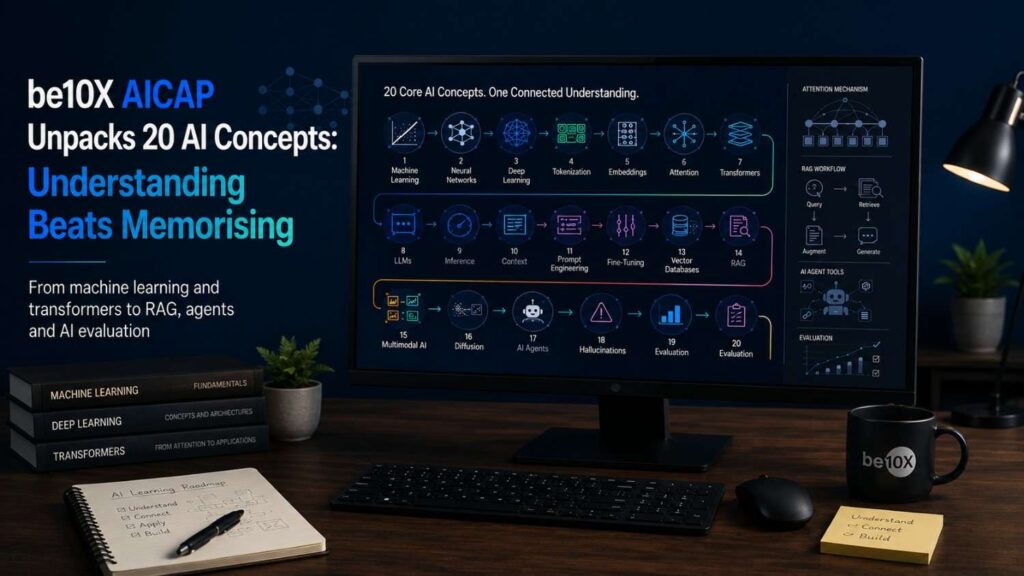
What follows is a map of that box: twenty ideas ordered so each sets up the next, from how a model learns to how anyone tells whether it is any good
Part One: How a machine learns anything
1. Machine Learning
Traditional software is a list of instructions a person wrote. To catch spam the old way you wrote rules: block “free money,” block six exclamation marks. Spammers adapt, rules break, you write more forever.
Machine learning inverts the job. You supply thousands of examples already labelled spam or not spam, and a program works out the patterns separating them. Nobody writes the rulebook; it is discovered from evidence.
The field exploded because many problems are easy to demonstrate and impossible to describe. Nobody can write rules for recognising a friend’s face, but anyone can point at a thousand photos.
2. Training Data
Everything a model knows arrives through its training data: web text, books, code, transcripts, licensed archives.
A cook can only produce dishes from what the pantry holds. Stock nothing but Italian ingredients and you get excellent pasta and no dal, whatever the cook’s talent.
This explains behaviour that looks random. Models are stronger in English than Marathi because far more English text exists online, they reproduce biases sitting in the source material, and they know nothing after their data was collected.
3. Neural Networks
So what absorbs all that data?
Picture a machine with millions of adjustable dials. Information enters one end, a prediction comes out the other. At first the dials are random, so the output is nonsense. Each time the machine is wrong, an automatic process nudges every dial slightly in whichever direction would have made the answer less wrong.
Repeat billions of times and those settings encode the statistical structure of the data. The dials are what people call parameters, so a 70-billion-parameter model has roughly that many.
4. Deep Learning
Deep learning means stacking many such layers rather than a few.
Depth lets the machine build understanding in stages, the way an assembly line adds complexity station by station. In an image model, early layers detect edges and colour shifts, middle layers assemble shapes and textures, later layers assemble those into eyes, wheels and leaves. No engineer designed that hierarchy; it emerged because depth was the cheapest way to reduce error.
Part Two: What your sentence becomes inside the model
Learning happens once, during training. What happens the moment you press Enter?
5. Tokenization
Your sentence becomes numbers first, chopped into tokens: chunks drawn from a fixed vocabulary the model was built with.
Tokens are not words. “The” is one token. “Unbelievable” might split into three pieces, a rare name into five.
This has consequences. Token counts drive API pricing, which is why long documents cost more. And because the model sees chunks rather than letters, counting letters in a word is awkward for it, not because the task is hard but because the letters were never separately visible.
6. Embeddings
Each token then becomes a long list of numbers called an embedding.
The tempting shortcut is to call an embedding the meaning of a word. It is not. It is a numerical representation whose position captures relationships the model observed in training. Words used in similar situations acquire similar number patterns, which is a statistical property rather than comprehension.
Imagine a map with hundreds of directions instead of two. “Doctor” and “nurse” sit close because they appear in overlapping contexts. Distances carry usable information, even though nothing on the map knows any medicine.
7. The Attention Mechanism
Single tokens are ambiguous. “Charge” means different things in a hospital, a courtroom and a car park. Context resolves it, so tokens need to influence each other.
Attention does that. For each token it calculates a relevance score against every other token in the input, then builds a fresh, context-adjusted representation weighted by those scores. In “she left the bank and drove home,” the representation of “bank” gets pulled toward leaving and driving, away from finance.
The detail that matters: this is a calculation over relationships, not a spotlight on important words. Every token is compared with every token, and the weights decide how much each contributes.
8. Transformers
Attention is a component. The transformer is the architecture built around it.
A transformer stacks many blocks, each holding an attention step plus a small processing network, with normalisation and shortcut connections that keep training stable. Text moves up through the stack, gaining refinement at every level.
Why it displaced everything before it is unglamorous but decisive. Older designs read text strictly in sequence, one word at a time, so training was slow. Attention compares all tokens at once, letting training spread across thousands of chips in parallel.
9. Large Language Models
Train a large transformer on an enormous quantity of text with one objective, predicting the next token, and you get a large language model.
That sounds trivial, which is where the “just autocomplete” dismissal comes from. It misses what the task demands: predicting the next token well across grammar, code, arithmetic, translation and dialogue requires internalising a great deal of structure about how those domains behave.
The honest position sits between the extremes. An LLM does not reason the way a person does, and it is also not a lookup table. Its narrow training objective produced capabilities nobody programmed directly.
10. Inference
Training builds the model. Inference is using it.
If training is constructing a factory over months at vast cost, inference is one order moving through in seconds. The weights are frozen. Your prompt enters, tokens are generated one at a time with each new token fed back as part of the input, and generation halts at a stop signal or a length limit.
Every response burns computation, which is why so much effort goes into making models smaller and faster.
Part Three: Shaping how a model behaves
The same model can feel brilliant or useless depending on how it is used. Three levers explain most of that gap.
11. Context Windows
The context window is the total text a model can consider at once, measured in tokens and covering system instructions, the conversation so far, any pasted documents, and the answer being written.
It resembles desk space more than memory. Everything the model works with has to be laid out on that desk. When a conversation outgrows the limit, earlier material is dropped or summarised, which is why long chats lose details from the beginning.
No permanent learning happens here. Nothing you type alters the weights. Products that appear to remember you are storing notes elsewhere and quietly putting them back on the desk.
12. Prompt Engineering
Since the context window is all the model has, what goes into it does most of the work.
The useful comparison is briefing a capable freelancer who knows nothing about your company and cannot ask questions before delivering. Vague brief, generic output. Supply role, audience, constraints, format and one example of good work, and the result shifts sharply.
Two techniques carry most of the value. Showing a worked example beats describing one. And asking for reasoning before the final answer improves accuracy on multi-step problems, because those steps become part of the input later tokens are conditioned on.
13. Fine-Tuning
Sometimes prompting is not enough. Fine-tuning continues training an existing model on a smaller curated set of examples, adjusting the weights.
This is apprenticeship, not education. The model already has the language; fine-tuning teaches it your conventions, tone, output format and categories.
A common and expensive mistake is treating it as a way to install new facts, the trap be10X takes apart in fine-tuning teaches format, not facts. Facts change, retraining is slow, and the model may blend new material with old patterns.
Part Four: Connecting a model to information it never saw
14. Vector Databases
Suppose an insurer wants a support assistant answering from its own policy documents, none of which were in the training data.
The first requirement is finding passages by meaning, not wording, because a customer asks about “damage from a flooded basement” while the policy says “water ingress.” Keyword search fails, which is precisely the gap a vector store fills alongside SQL.
A vector database stores embeddings of every passage and returns those whose number patterns sit closest to the embedding of the question. Closeness there correlates well with topical relatedness, so results look semantically smart. Nothing in the database understands insurance; it measures distance.
15. Retrieval-Augmented Generation
RAG puts this to work in three distinct stages.
Retrieval: the question is embedded and used to pull the most relevant passages from the store.
Injection: those passages go into the prompt alongside the question, with an instruction to answer from the supplied material.
Generation: the model writes an answer, working from documents in its context window rather than from memory.
Update a policy and answers update instantly, with no retraining. Responses can cite sources. And with the text present in the input, the model has far less room to invent.
Part Five: Beyond text
16. Multimodal AI
Multimodal models handle images, audio and video alongside text in one system.
The underlying trick follows everything above. An image is divided into patches, each patch becomes a representation, and those flow through the same stream as text tokens. Once everything shares a numerical space, attention can relate a phrase to a region of a photograph.
That is what lets you photograph a broken appliance and ask what the part is called, or hand over a chart and ask what the trend implies.
17. Diffusion Models
Image generators run on a different principle, worth knowing because the two families get confused.
A diffusion model is trained by taking real images, adding random noise step by step until nothing recognisable survives, and learning to reverse each step. Generation starts from pure noise and removes it gradually, guided by your description, until a coherent image appears.
Sculpture is the closer comparison than writing. The model is not composing left to right like a language model. It refines a whole field of noise toward the prompt across many passes.
18. AI Agents
The word agent gets attached to anything automated, which drains it of meaning. A scheduled script that emails a weekly report is automation.
An agent has four parts working together. A model that decides what to do next. Tools it can genuinely call, such as search, a database or an email API. State, meaning a record of what it has already tried. And a loop, so it acts, observes the result, and decides again rather than running a fixed sequence.
A research assistant that takes a vague question, runs several searches, spots a gap, searches again and assembles a sourced summary qualifies. Its steps are chosen at runtime, not written in advance.
Part Six: Where it breaks, and how anyone would know
19. AI Hallucinations
A hallucination is output that is fluent, well-formed and wrong: invented citations, fictional product features, a confidently fabricated date.
The cause follows from the mechanics. A model generates tokens that best fit its training patterns, and fluency is what it was optimised for. Factual correctness was never a separate objective. Where knowledge is thin, no internal alarm sounds; the model produces the most plausible continuation, and plausible text is exactly what a convincing fabrication looks like.
So this is not a bug awaiting a patch. It is a property to manage, through grounding in retrieved documents, required citations, and human review wherever being wrong is costly.
20. AI Evaluation
If a model can be confidently wrong, and prompt changes shift behaviour unpredictably, how does anyone know whether an AI feature is improving?
That is what evals are for. An eval is a structured test set: representative inputs, a definition of good output, and a repeatable way to score performance. It is the AI equivalent of a software test suite.
It matters because these systems fail asymmetrically. Rewrite a prompt to fix a formatting complaint and you may quietly wreck accuracy on a category nobody thought to check. Spot-checking a few examples cannot catch that. A scored set of a few hundred cases, run before every change, can.
Teams that ship reliable AI products are rarely the ones with the cleverest prompts. They are the ones who measure.
How the 20 AI Concepts Fit Together
Read as one chain, the twenty ideas describe a single pipeline.
Training data feeds a machine learning process, which adjusts the weights of a deep neural network built as a transformer, whose attention mechanism relates tokens to one another. Trained at scale on next-token prediction, it becomes a large language model. At inference your text is tokenized, turned into embeddings, and processed inside a context window. What you put in that window is prompt engineering. Fine-tuning shapes behaviour, retrieval from a vector database through RAG supplies knowledge. Multimodal capability widens the inputs, diffusion models generate images, and agents add tools, state and a decision loop so the system can act rather than only answer. Hallucinations are the failure mode all this creates, and evals are how anyone finds out.
The best next step is building something small. Write a prompt with a worked example and see what changes. Load ten of your own documents into a retrieval setup and question them. Then write twenty test cases and score the answers. Anyone weighing up the best AI course for turning these concepts into working systems will find the pipeline covered end to end inside be10X’s AI Career Accelerator Program.
Further reading: Top 5 AI Courses in India for Students and Freshers.
The 20 concepts at a glance
- Machine Learning. Patterns learned from examples, not hand-written rules.
- Training Data. What a model learns from; source of strengths and blind spots.
- Neural Networks. Adjustable weights tuned by repeated error correction.
- Deep Learning. Stacked layers building features from simple to complex.
- Tokenization. Text split into fixed-vocabulary chunks, not words.
- Embeddings. Number lists whose positions capture learned relationships.
- Attention. Relevance scored between all tokens, reweighted by context.
- Transformers. The layered architecture around attention, built for parallelism.
- Large Language Models. Big transformers trained on next-token prediction.
- Inference. Running the frozen model; where cost and latency sit.
- Context Windows. Tokens available in one interaction, not memory.
- Prompt Engineering. Building the input deliberately, with examples.
- Fine-Tuning. Extra training to shape style, format and behaviour.
- Vector Databases. Passages retrieved by numerical closeness of embeddings.
- RAG. Retrieve, inject into the prompt, then generate.
- Multimodal AI. Images, audio and text in one shared representation space.
- Diffusion Models. Images made by reversing added noise.
- AI Agents. Model, tools, state and a loop choosing steps at runtime.
- Hallucinations. Fluent unsupported output; plausibility was the objective.
- AI Evaluation. Scored testing of representative cases before every change.
