
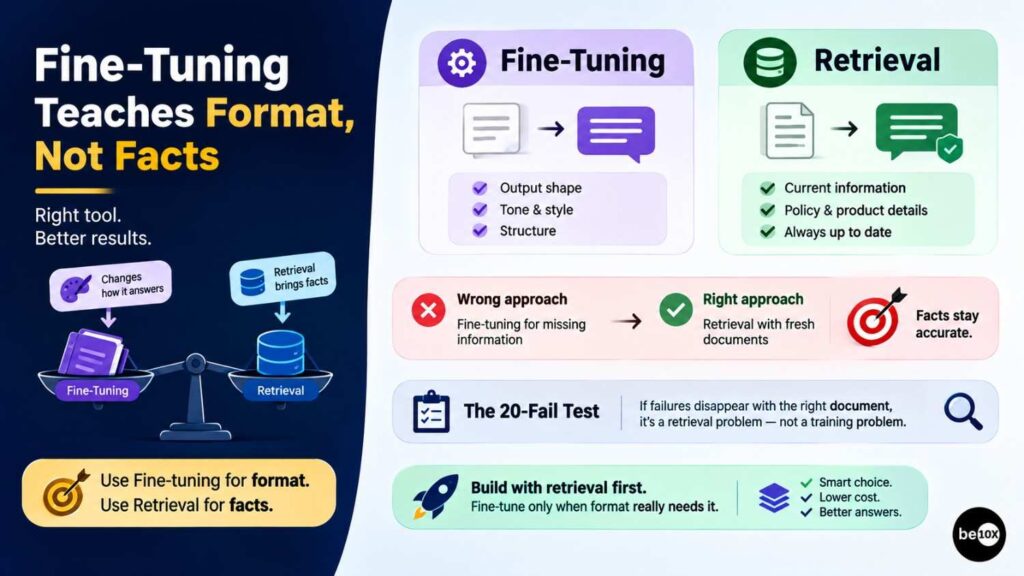
Fine-tuning is the most expensive misunderstanding in applied AI. A team watches a model get the company’s product details wrong, concludes that the model needs to learn the business, and commissions a custom version of it. What comes back writes in a pleasant house voice and still gets the product details wrong. The budget went to a real capability that was never going to solve the problem in front of it.
Two problems that look identical from the outside
When a model produces a bad answer, the cause sits in one of two buckets, and they are easy to confuse. Either the model does not know something, or it knows the thing and is presenting it badly.
Not knowing looks like an invented policy clause, a price that was never on any list, a refund window quoted at fourteen days when the actual figure is seven. Presenting badly looks like correct information arriving in the wrong shape: four paragraphs where the team wanted three fields, a formal register on a brand that speaks casually, a summary that buries the decision under the background.
Fine-tuning is a treatment for the second bucket. It gets bought as a treatment for the first.
What training on examples actually changes
Fine-tuning takes a model that already works and shows it several hundred or several thousand examples of one task done the way a particular organisation wants it done. Each example is an input paired with the ideal output. The weights shift slightly, and the model’s default behaviour drifts toward the pattern in those examples.
What shifts is behaviour. Output shape, level of formality, length, the order information is presented in, how a familiar edge case gets handled. A support team sitting on eight hundred well-written past replies can produce a model that answers in the shape of those replies without being told the format in every single request. That is a genuine result, and for high-volume repeated tasks it is worth paying for.
What does not shift reliably is knowledge.
Why the facts refuse to stick
A model does not store a fact the way a spreadsheet stores a cell. It absorbs statistical patterns across an enormous amount of text, and a few thousand examples cannot outweigh that scale in any dependable way. The refund window mentioned twice in the training file competes against everything the model has ever read about refund windows, and it usually loses.
Worse, research on what happens when models are trained on unfamiliar information found that fine-tuning on new knowledge correlates with more hallucination, not less. The model learns the confident shape of an answer it does not actually have, and applies that confidence more widely.
There is also a maintenance problem hiding underneath. Facts change. A price list moves, a policy is revised, a product is withdrawn. Knowledge baked into weights can only be corrected by training again, which turns every small factual update into a project.
The cheaper thing that was usually needed
When the failure is missing information, the fix is retrieval rather than training. The system looks up the current document and hands it to the model along with the question, so the answer is grounded in a source instead of recalled from a statistical average. Be10X’s explainer on why AI keeps making things up and what actually fixes it walks through how that pipeline is assembled.
Imagine a customer asks, “Can I return the Pro plan after upgrading?” Instead of relying on what it remembers, the system retrieves the latest refund policy from the company’s knowledge base and includes it in the prompt. The model then answers using that document, so if the policy changed yesterday, the response changes too, without any retraining.
Retrieval also fixes the maintenance problem. Updating the answer means updating the document, and the next query picks it up. The lookup works on meaning rather than exact wording, which is why a question phrased nothing like the source can still surface the right paragraph, a mechanism covered in Be10X’s post on how AI actually understands language.
When fine-tuning genuinely earns its cost
There are conditions where the spend makes sense. The task is narrow and repeated at volume. The desired output shape is stable and hard to describe in words but easy to demonstrate with examples. Prompts have grown long and expensive because the instructions keep expanding. Response speed matters enough that a shorter prompt is worth real money. Under those conditions, fine-tuning turns a fragile instruction into a default, and the savings compound.
Notice that none of those conditions involve teaching the model something it did not know.
The test worth running before spending anything
Twenty failed outputs are enough to settle the question. For each one, the diagnostic is whether the failure would have disappeared if the correct document had been sitting in front of the model. If most answers are yes, the problem is retrieval and fine-tuning will not touch it. If most are no, because the information was right and the delivery was wrong, then the format problem is real and fine-tuning is the correct instrument.
The AI Fundamentals and automation modules in the AI Career Accelerator Program at Be10X cover this distinction with hands-on builds, because the difference between a knowledge gap and a format gap is far easier to see once a retrieval system has been built and watched as it fails.
