
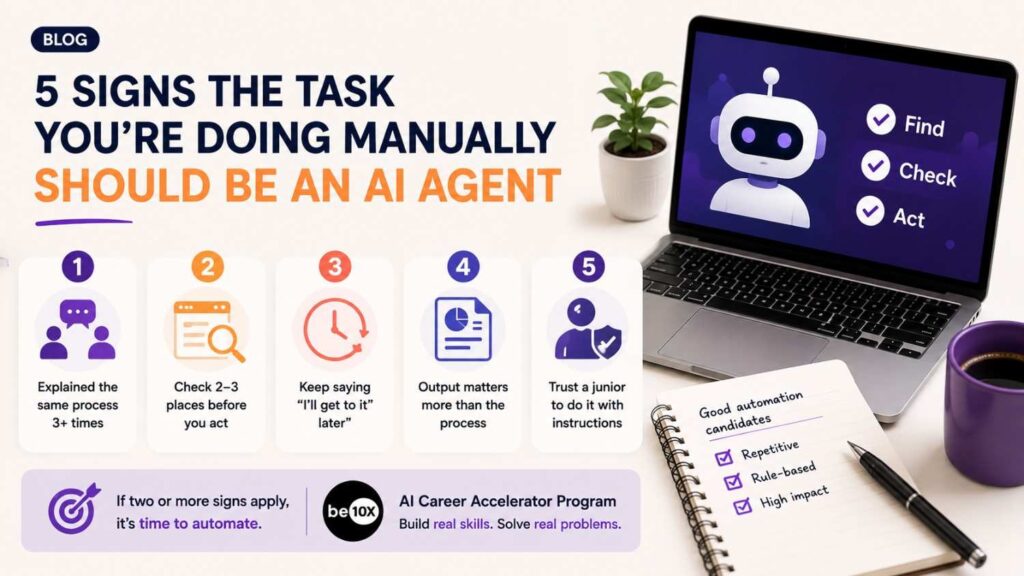
Not every repetitive task needs an agent. Some just need a better checklist. But a few specific signs reliably mean you’re sitting on something worth automating properly, not just doing faster by hand. Here’s how to tell the difference.
1. You’ve explained the same process to someone else at least three times
If you’ve had to walk a teammate, a new hire, or your future self through “here’s how I handle this” more than a couple of times, that’s not a training problem. It’s a sign the process is well-defined enough to hand to an agent instead of a person. Anything you can explain as a clear sequence of steps is a candidate. Anything that requires genuine case-by-case judgment every single time usually isn’t, at least not yet.
2. The task involves checking two or three places before you can act
Most manual busywork isn’t actually hard, it’s just scattered. Checking an inbox, then a spreadsheet, then a dashboard, before deciding what to do next, is exactly the kind of friction an agent removes. The individual steps are simple. Doing them in sequence, every day, without missing one, is where the time actually goes.
3. You keep saying “I’ll get to it later” and then don’t
This is the most honest signal of all. If a task keeps sliding down your list not because it’s hard but because it’s tedious, it’s telling you something: it’s important enough to matter but boring enough that a person shouldn’t be the one doing it. That gap between “should happen” and “actually happens” is precisely where an agent earns its keep.
4. The output is more valuable than the process, and nobody would notice if a machine did the process
Be honest about which parts of your work people actually value. Nobody’s impressed by the fact that you personally copy-pasted data from one sheet to another. They care about the report that came out of it. When the process is invisible and only the outcome matters, that process is a strong automation candidate, not a point of pride.
5. You’d trust a well-trained junior teammate to do it, with clear instructions
This is the simplest filter. If you’d hand this task to a capable junior colleague with a written set of instructions and trust them to get it right most of the time, you can hand it to an agent with those same instructions. If you wouldn’t trust anyone but yourself to do it because it requires deep context or high-stakes judgment, that’s a sign to keep a human in the loop, at least for now.
What to Do With This
If two or more of these apply to something on your plate right now, that’s usually enough signal to stop doing it manually and start scoping it as an agent. You don’t need a technical background to build one anymore, no-code platforms have made this genuinely accessible to anyone willing to sit down and map the process out clearly.
This kind of practical, build-it-yourself thinking is exactly what the AI Agents module of the AI Career Accelerator Program at be10x is built around, not theory about what agents are, but actually identifying and building one for a real task sitting on your plate. Explore what’s covered in AI Agents with n8n and Workflow Automation with Make.

