
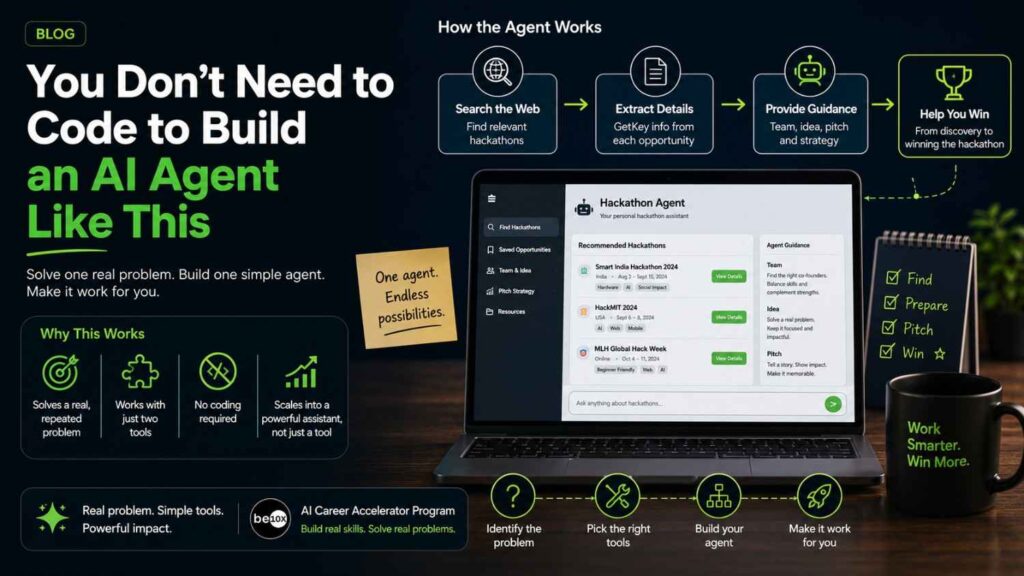
Think of a problem you keep solving manually, then ask a simple question: could an AI agent just do this for me? Here’s what that looks like in practice: an AI agent built purely to solve one recurring, specific problem, finding hackathons worth entering and helping someone prepare to actually win one.
Think about how many “how do I even start” questions live inside a task like that. Where do I find relevant hackathons? What details do I need before applying? How should I think about my team, my idea, my pitch? Instead of answering that manually every time, the idea was simple: build an agent that answers it directly, on demand, for anyone who needs it.
What an Agent Like This Actually Looks Like
Strip it down and it’s really just two capabilities working together. One tool searches the web for relevant, current opportunities. A second tool goes deeper, pulling the actual details straight from each opportunity’s page, so the agent isn’t just handing back a list of links, it’s handing back the specific information someone needs to act.
But the more interesting part isn’t the search step. It’s that an agent like this doesn’t have to stop at “here’s an opportunity.” It can go further into strategy: how to form a team, how to shape an idea, how to structure a pitch that actually lands. That’s the difference between a lookup tool and something that behaves like a knowledgeable assistant walking you through an entire process.
Why This Is a Genuinely Good Idea
A few things about this pattern are worth paying attention to if you’re thinking about building your own version of it:
It starts from a real, specific, repeated problem. The best agent ideas rarely start with “I want to build an AI agent.” They start with a question you keep answering manually, or a task you keep repeating. That’s a better starting point than picking a tool first and looking for a problem to justify it.
It works with just two tools, not ten. A common mistake with agent-building is reaching for every available integration because it’s technically possible. An agent like this works because it’s scoped tightly: one tool for finding opportunities, one tool for getting the details. Two well-chosen tools that do their job cleanly beat a bloated agent every time.
It doesn’t require writing code. This is the part that matters most for anyone who’s been sitting on the sidelines assuming agent-building requires an engineering background. Visual, no-code platforms now make it possible to wire together a search tool, a scraping tool, and a reasoning layer without touching a backend. The barrier to entry for building something like this has genuinely collapsed in the last year.
The Bigger Takeaway
The hackathon use case is just one version of this. The real pattern underneath it applies to almost any recurring question or manual task you deal with: identify what you keep getting asked or keep doing by hand, scope it down to the smallest set of tools that would actually solve it, and build it without assuming you need to know how to code first.
That’s genuinely the accessible version of AI agent-building right now, and it’s exactly the kind of hands-on, real-project approach we lean into in the AI Agents module of the AI Career Accelerator Program at be10x, where the goal isn’t just understanding how agents work in theory, but actually building one, end to end, for a problem that matters to you. If this idea has you thinking about what your own version might look like, explore what’s covered in AI Agents with n8n and Build AI Agents for Your Enterprise.

