
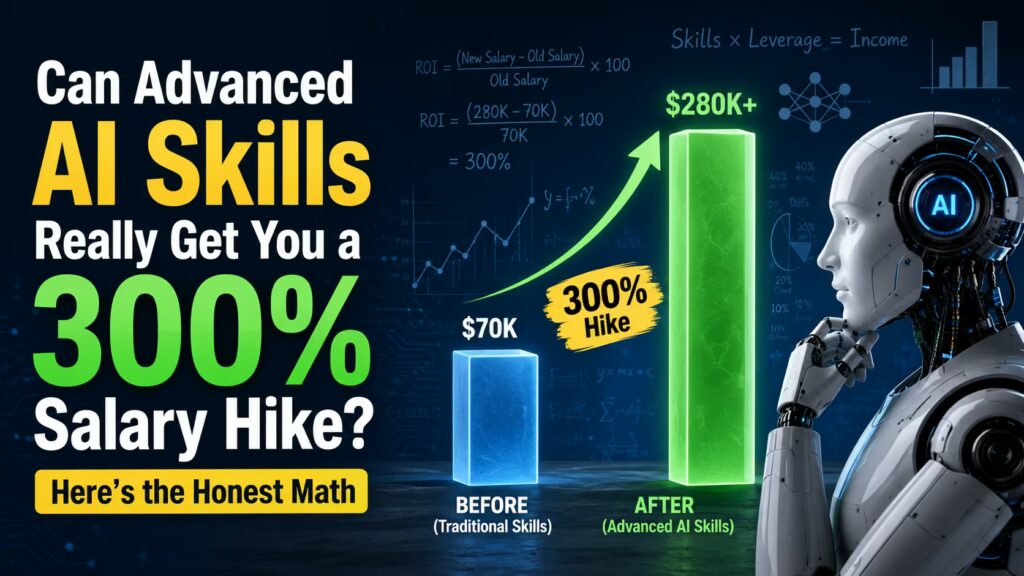
Search “AI skills salary hike” and you’ll find every number imaginable thrown around, 20%, 40%, 300%, with almost none of them explaining what actually has to be true for a number that large to happen. So let’s be precise about it. A 300% hike is real and achievable, but it’s not what “learning AI” alone gets you. It’s what happens when advanced AI skill sits underneath two or three other levers, role change, market repositioning, and specialization, all pulling in the same direction at once. Here’s what that actually looks like, and why most people stop at the first lever instead of stacking all of them.
The Baseline: What “Typical” AI-Driven Hikes Actually Look Like
Before talking about outliers, it’s worth being honest about the average. Professionals who complete structured AI upskilling programs, be10x among them, commonly report average salary hikes in the range of 40%, alongside promotions and productivity gains. That’s a real, solid outcome, and it’s already well above typical annual raises in most industries.
Outliers exist too. One documented case involved a technology analyst who used AI-tool fluency to cut a reporting process from six-to-ten hours down to about thirty minutes, then secured a new role with a 150% salary increase. That’s a meaningfully bigger jump, but notice what’s actually in that story: it wasn’t a raise at the same company for the same role. It was a role change, layered on top of a skill upgrade.
Why it matters: the size of the hike tracks closely with how many levers are being pulled, not just how many AI tools someone learned. A 40% internal raise and a 150% new-role jump are different categories of outcome with different mechanisms behind them.
Lever One: Time Optimization Inside Your Current Role
The first, most common lever is straightforward: use AI to compress the time a task takes, and redirect that freed-up time toward higher-value work your manager actually notices. An operations manager who completed be10x’s Advanced AI Careers Accelerator Program reported a roughly 60% cut in reporting workload, freeing up time that went toward cross-functional coordination and the confidence to pursue leadership roles he’d previously avoided.
This lever alone rarely produces a 300% outcome. It produces something more modest but very real: visible productivity gains that make you promotable, and stronger negotiating leverage at review time.
Actionable takeaway: Track the specific hours you save using AI tools over a month. That number, not a vague sense of “being more efficient,” is what you bring into a compensation conversation.
Lever Two: Role or Company Change
Internal raises are almost always capped by company pay bands, no matter how much value you’re adding. The bigger jumps consistently come from moving, to a new company, a new function, or a role that didn’t exist on your resume a year ago. This is the lever behind the 150% case above, and it’s also the lever behind a documented example of a laid-off professional who, within a month of completing AI training and building fluency with tools like NotebookLM, received two job offers above ₹20 lakh per annum.
Why it matters: a layoff or plateau often looks like the worst possible moment to negotiate. In practice, it’s frequently the moment advanced AI skills convert most directly into salary, because you’re negotiating a new band entirely, not asking your current employer to stretch an existing one.
Actionable takeaway: If your current company’s pay structure has a hard ceiling, treat advanced AI fluency as market-facing leverage, not just an internal productivity boost. It travels with you.
Lever Three: Specialization Premium
Generic AI literacy, knowing how to prompt ChatGPT reasonably well, is quickly becoming table stakes rather than a differentiator. The premium now sits one level deeper: being the person in your function who can combine multiple AI tools into a working system for a specific business problem, financial forecasting, Power BI dashboards that update themselves, or an HR workflow that used to take a team a week.
This is the shift be10x’s own more recent programming reflects, moving learners from single-tool competence (the AI Tools Workshop) toward systems-level, role-specific application (the Advanced AI Careers Accelerator Program). It’s also the shift the broader market is pricing in: research from Princeton, Georgia Tech, and IIT Delhi and multiple 2026 industry analyses consistently point to specialized, applied AI skill commanding a real premium over general awareness.
Actionable takeaway: Don’t stop at “I know how to use ChatGPT.” Pick one function-specific workflow, financial modeling, campaign reporting, dashboard building, and become the person who’s automated it end to end.
Stacking the Levers: Where a 300% Outcome Actually Comes From
Put those three levers together and the math starts to make sense. Someone who optimizes their current role (lever one) builds visible proof of impact. That proof becomes the case for a role or company change (lever two), often into a function or industry where AI specialization is scarce and therefore expensive (lever three). Each lever compounds the next rather than adding to it.
A 300% hike isn’t what happens when someone finishes a workshop. It’s what happens when a professional uses the workshop as the starting proof point, builds a specific, demonstrable specialization over months, and then times a deliberate role or industry change around that specialization while the market for it is still underserved. It’s rare, it’s not guaranteed, and it requires more than training alone, but it’s a real, mechanically explainable outcome rather than a marketing number pulled from nowhere.
Actionable takeaway: If you’re aiming for an outsized outcome, plan for all three levers explicitly. Set a 90-day goal for lever one (a measurable time-savings win), a 6-month goal for lever three (a specific specialization you can point to), and treat lever two as the payoff you pursue once the first two are real, not the starting move.
What This Isn’t
To be direct about it: a 300% hike is not the typical outcome of any AI course, be10x’s or anyone else’s, and no credible program should promise it as a standard result. It’s a ceiling reached by a small number of people who stack multiple levers deliberately over time, not a floor everyone who enrolls should expect. The documented, typical outcomes, around a 40% average hike, meaningful time savings, and stronger job security, are themselves a strong return on a few hours of training. Treat anything higher as a stretch goal built on top of that foundation, not the baseline pitch.
Final Takeaway
Advanced AI skills can absolutely change your career, and in specific, documented cases they’ve driven hikes well above what a typical annual raise would ever produce. But the honest version of that story isn’t “learn AI, get 300% more.” It’s “optimize your current role visibly, build a specific specialization the market is underserved on, and time a role change around that specialization”, three separate, deliberate moves that compound into an outcome far bigger than any one of them alone.
Frequently Asked Questions
Is a 300% salary hike from learning AI skills realistic?
It’s possible but not typical, and it generally requires combining role optimization, a job or company change, and a specific market-facing specialization, not AI training alone.
What’s a more realistic expectation for salary growth after AI upskilling?
Documented average outcomes sit around a 40% salary hike, with some individual cases, typically tied to a role change, reaching 150% or higher.
Does staying at the same company limit how much an AI skill upgrade can increase pay?
Often, yes. Internal raises are typically capped by existing pay bands, while role or company changes allow negotiation into an entirely new compensation range.
What kind of AI skill commands the biggest premium right now?
Function-specific, systems-level application, combining multiple AI tools to solve a specific business workflow, tends to command more of a premium than general AI tool familiarity alone.
