Table of Contents
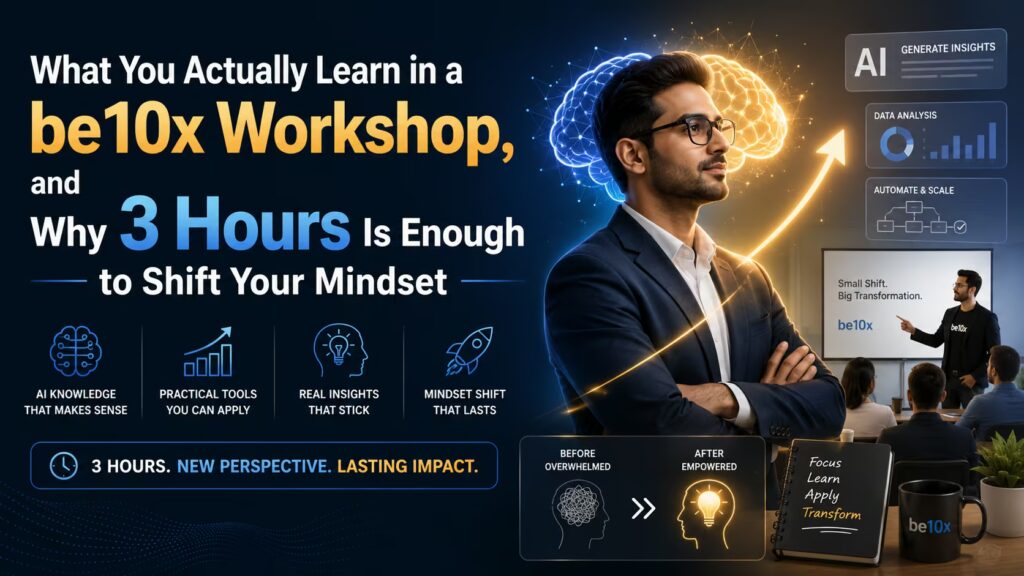
Three hours doesn’t sound like enough time to change how you think about your entire career. That’s usually the first objection people have before joining a be10x workshop, and it’s a fair one. Most professional training that claims to be “transformative” is a full-day seminar or a multi-week course. be10x’s flagship AI Tools Workshop runs a single live session, and yet the most common thing learners report afterward isn’t “I learned some new software.” It’s “I think about my job differently now.”
Here’s what actually happens during those three hours, and why the shift tends to outlast the session itself.
Hour One: Realizing You’ve Only Been Using 10% of What’s Available
Most people walk in already using ChatGPT or a similar tool in some basic way, mostly as a smarter search engine or a first-draft generator. The first real shift happens almost immediately, when the session moves past that surface use and into the ten or more AI tools most learners didn’t know existed or didn’t know how to apply. One participant, already a software developer using ChatGPT, Perplexity, and Claude regularly, described being genuinely surprised by how much of AI’s actual capability they’d been missing, despite already considering themselves a regular user.
Why it matters: the mindset shift doesn’t start with learning something brand new. It starts with discovering how much untapped capability was already sitting in tools you thought you understood. That’s a more disorienting, and more motivating, realization than being introduced to AI for the first time.
What this looks like in the session: live demonstrations across the chat layer (ChatGPT, Claude, Gemini), automation tools, and specialized platforms like NotebookLM, each tied to a specific, recognizable work task rather than an abstract feature tour.
Hour Two: Watching Your Own Work Get Solved in Real Time
This is where the format itself does most of the work. Because the workshop is live and interactive rather than pre-recorded, instructors work through real automation examples, Excel formulas generated through natural-language prompts, Power BI dashboards built in minutes instead of hours, PowerPoint decks assembled from a rough outline, using the kind of tasks learners actually deal with, not toy examples built for a slide.
One reviewer described initially expecting the workshop to only cover ChatGPT, then finding it worth the full three and a half hours because of how many additional tools were demonstrated with direct, practical application. Another described leaving with tools they could use the same day, not a certificate to file away.
Why it matters: watching a six-hour reporting task collapse into thirty minutes in front of you does something a lecture about AI’s potential can’t. It moves AI from a concept you’ve heard about to a capability you’ve now personally watched work on a problem you recognize.
What this looks like in the session: step-by-step live demos, screen-shared workflows, and direct Q&A where learners can ask about their specific job function, whether that’s HR tracking, financial reporting, content creation, or teaching.
Hour Three: The Fear Reframe
The most consistently reported shift happens toward the end of the session, and it’s less about tools and more about posture. Multiple learners have described walking in anxious, specifically worried about AI replacing their role, and walking out with that anxiety replaced by a sense of direction. One reviewer put it plainly: the session didn’t just calm those fears, it flipped the entire framing, from AI as a threat to be endured to AI as a skill to be claimed.
This is where Kachave and Goenka’s core message lands hardest, delivered not as a slide but as something learners have just experienced directly: AI won’t replace you, but someone who’s learned to use it well might. By hour three, that line isn’t abstract anymore. Learners have just spent two hours watching exactly what “using it well” looks like, and the fear tends to convert into urgency instead, a very different, much more useful emotion.
Why it matters: most career anxiety persists because it has nowhere productive to go. Replacing “I might get replaced” with “here’s specifically what I’m going to automate on Monday” is a mindset shift, not just a skills upgrade, and it’s the part learners consistently describe as the real value of the session.
Why the Shift Outlasts the Workshop
A single session creating a temporary sense of motivation isn’t unusual, plenty of seminars do that for a weekend. What’s different about be10x’s format is what happens immediately after: learners get access to a community of fellow participants, ongoing live doubt-clearing calls, and a structured next step (the Mastery Course or Advanced AI Careers Accelerator Program) rather than being left to sustain the momentum alone.
That combination, an immediate hands-on proof point, followed by a support structure instead of a hard stop, is what tends to convert a three-hour spike in motivation into an actual, lasting change in how someone approaches their work. Reviewers have specifically cited the weekly live calls and peer network as reasons the shift from the workshop didn’t fade the way a typical seminar high usually does.
Actionable takeaway: After any high-energy training session, the real test is what happens in week two, not day one. Look for programs that build in follow-up support, not just a single session and a certificate.
What to Actually Expect Walking In
To set realistic expectations: you won’t leave a three-hour workshop as an AI expert, and be10x doesn’t claim you will. What you can expect is a working knowledge of ten or more tools relevant to your actual job, at least one automation you can apply immediately, and a clearer, less anxious framework for how to keep learning from there. The deeper technical depth, and the more dramatic career outcomes, come from what learners choose to do after the workshop, not from the three hours alone.
Actionable takeaway: Walk in expecting a starting point and a mindset reset, not a finish line. The learners who report the biggest career changes are consistently the ones who used the workshop as a first step, not a one-time event.
Final Takeaway
The reason a three-hour workshop can genuinely shift someone’s mindset isn’t magic, and it isn’t just good instruction, though the live, hands-on format matters. It’s the sequencing: first showing you how much capability you were missing, then proving it live on a problem you recognize, and only then reframing the fear that brought you into the room in the first place. By the time learners leave, AI has stopped being a headline they’re anxious about and started being a specific set of tools they’ve already watched work. That’s a genuinely different starting point than the one most people walk in with.
Frequently Asked Questions
What topics does a be10x AI Tools Workshop actually cover?
Typically prompt engineering fundamentals, ChatGPT and other chat-layer tools, Office and Excel automation, Power BI basics, and tools like NotebookLM, demonstrated through live, work-relevant examples rather than lecture-style teaching.
Can a 3-hour workshop really change how someone thinks about their career?
Learners consistently report a shift from AI-related anxiety to a clearer, action-oriented mindset, driven less by the length of the session and more by watching real automation solve a recognizable work problem in real time.
Do I need to already know AI tools to benefit from the workshop?
No. The workshop is designed for beginners, and even learners who already use tools like ChatGPT regularly have reported discovering capabilities they weren’t previously using.
What happens after the workshop ends?
Learners get access to a community of fellow participants and ongoing live Q&A calls, along with the option to continue into be10x’s Mastery Course or Advanced AI Careers Accelerator Program for deeper, role-specific training.

