
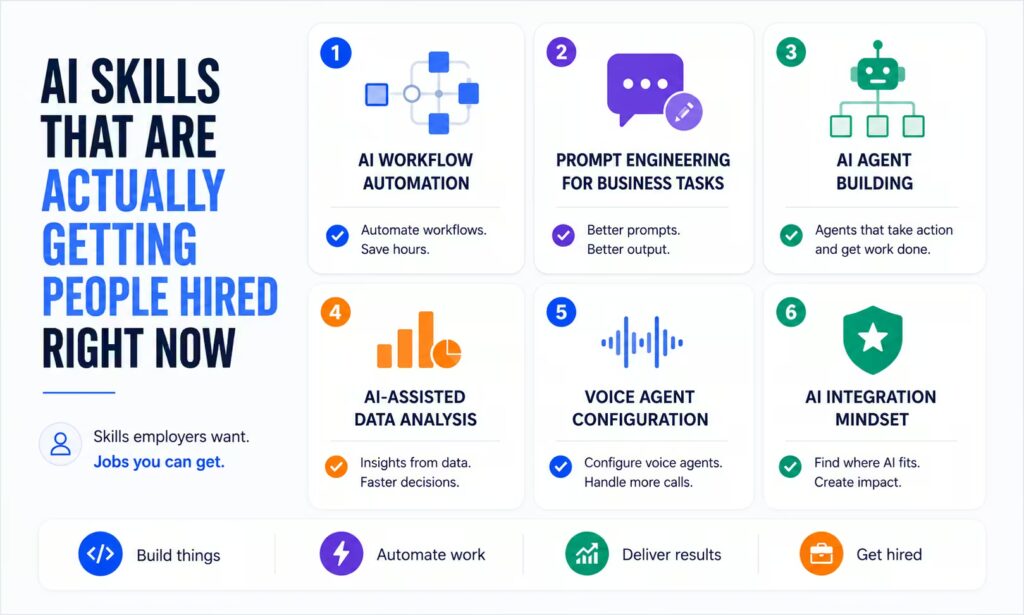
If you are looking for a one-line answer: the skills getting people hired in 2026 are not about knowing AI exists. They are about building things with it, automating workflows, and delivering output that did not need a developer to create.
Here is what is actually showing up in job descriptions and what hiring managers are asking about in interviews.
AI Workflow Automation
Tools like n8n and Make.com have moved from “nice to have” to appearing directly in job descriptions across operations, marketing, and product roles. Companies want people who can connect systems, reduce manual work, and build pipelines that run without constant supervision.
What this looks like in practice: pulling form responses, passing them through an AI summarisation step, pushing output to a sheet, triggering a notification. None of this requires coding. All of it requires understanding how data moves between tools.
If you cannot build at least a basic multi-step workflow, you are behind a growing portion of the applicant pool.
Prompt Engineering for Business Tasks
Not prompt engineering in the academic sense. The practical version — writing prompts that produce usable output for real business tasks. Reports, summaries, email drafts, data categorisation, content briefs.
The gap most candidates have is that they use AI conversationally but have never built a structured prompt for a repeatable task. That is what employers are actually testing for. Can you take a messy business problem and instruct an AI to handle it consistently.
AI Agent Building
This is the skill with the steepest learning curve and the least competition right now. Building agents that can take a goal, break it into steps, use tools, and complete tasks without someone managing every step.
Customer support agents with RAG, lead qualification bots, internal knowledge assistants — these are being built and deployed inside companies right now. Not as experiments. As operational infrastructure.
Candidates who can demonstrate they have built and delivered something like this — even a small project — are in a different conversation than candidates who have only used AI tools passively. Programs like be10x’s AI Career Accelerator have dedicated modules on this, covering n8n agents, RAG-based support bots, and voice agents, which gives learners actual project output to show rather than just a certificate.
AI-Assisted Data Analysis
Power BI, DataSquirrel, and AI-assisted analysis workflows are showing up in roles that previously required a data analyst background. Marketing managers, operations leads, business analysts — all expected to produce insights without waiting for a data team.
The skill is not deep analytics. It is knowing which tool to use, how to frame the question, and how to present the output to someone who needs to make a decision.
Voice Agent Configuration
Newer than the others but growing fast. Companies running sales, support, or onboarding over phone are deploying AI voice agents. Someone needs to configure them, write the call flows, test edge cases, and maintain them.
This is currently a skill very few people have and demand is ahead of supply.
What These Skills Have in Common
None of them are purely theoretical. All of them require you to have built something, even if small, that you can describe in an interview. The certificate question is largely irrelevant now. What interviewers are asking is: show me something you made.
The candidates getting hired are the ones who can answer that question.
Frequently Asked Questions
Which AI skill is most in demand for freshers in 2026?
AI workflow automation using tools like n8n and Make.com is the most accessible entry point for freshers. It does not require a coding background and directly addresses what operations and marketing teams need.
Do I need to know coding to build AI agents?
Not necessarily. Most agent building tools have visual interfaces. Understanding logic, data flow, and APIs helps but you do not need to write code from scratch to build and deliver functional agents.
How long does it take to learn AI automation skills?
With structured learning, most people get to a point where they can build real workflows within four to six weeks. Building more complex agents takes longer, typically two to three months of consistent practice.
Are AI skills enough to get a job or do I need a degree?
In 2026 most hiring decisions for AI-related roles weight demonstrated skill over degree. A project you can walk through in an interview carries more weight than a certificate alone.
What is RAG and why does it matter for jobs?
RAG stands for Retrieval Augmented Generation. It is the technique behind AI systems that can answer questions using a company’s own documents and data. Knowing how to build RAG-based systems is directly relevant to customer support, internal tooling, and knowledge management roles.
