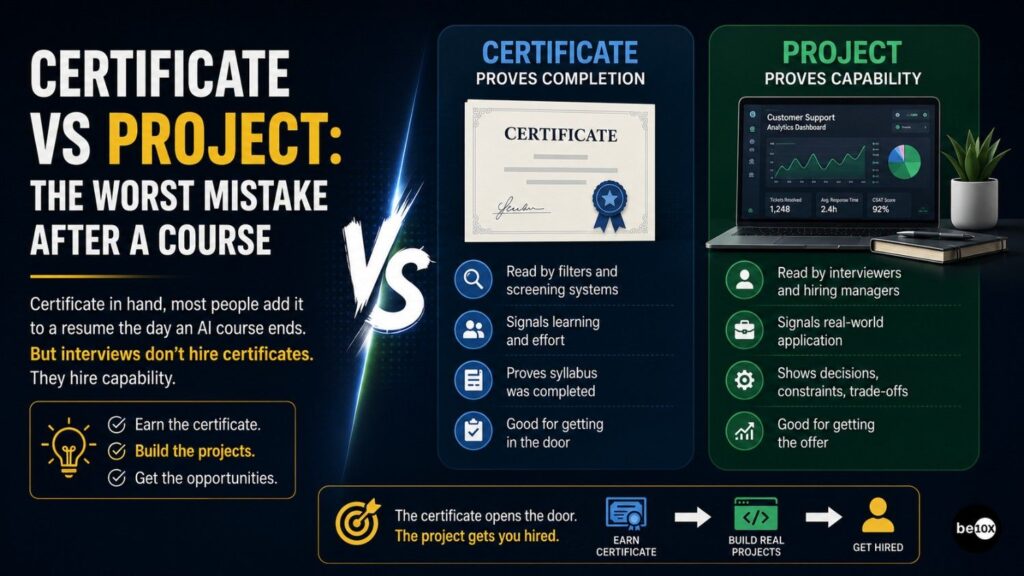
Certificate in hand, most people add it to a resume the day an AI course ends, and it is often the thing that never comes up once the interview starts. That is not because it is worthless. It is because a certificate and a finished project answer two different questions, and only one of them is the question being asked in the room. Knowing which is which changes how someone spends the weeks after a course ends.
A certificate proves completion, a project proves capability
A certificate confirms that a defined syllabus was covered and assessed. That is a real statement, and it is a statement about the course. A finished project is a statement about the person, because it shows a decision being made, a constraint being handled, and something reaching a working state. Interviewers are hiring the second thing, which is why the conversation drifts towards it within a few minutes.
The two are read by different audiences
A certificate does most of its work before a human is involved. Screening filters, keyword matches, and HR shortlists all respond to named credentials, and a candidate without one can be removed from a pile before anyone reads a word about their work. The project does its work after that point, in front of the person who will actually make the decision. Treating them as competitors misses that they operate at different stages.
Employers ask for specific skills, not general literacy
There is a reason hiring managers move past the credential quickly. They are trying to understand whether a candidate can apply AI to real work, not simply whether they completed a course. A named skill applied to a real problem gives them something concrete to evaluate. A certificate signals learning. A finished project demonstrates how that learning was put into practice.
A project does not have to be an application
This is where most people stall, assuming a build means code. Be10X’s account of what building with AI actually looks like for a working professional makes the case that for most people it means a repeatable workflow rather than software, and that prompts on their own are instructions rather than skills. A cleaned reporting process, a working automation, or a document pipeline that a colleague can run without help all count.
A rebuilt tutorial is a lesson, not a project
The distinction that matters is whether the problem belonged to somebody. A tutorial followed to completion proves attendance a second time. A messy task from an actual job, solved end to end with the compromises visible, is the artefact that survives questioning. The compromises are the interesting part, because they are the only evidence of judgment.
Two or three artefacts beat a long list
Volume works against the candidate here. Be10X’s roadmap for becoming AI ready suggests building a small number of portfolio projects and sharing them publicly, which is the right instinct, because a short list invites depth while a long one invites suspicion. Three things explained well is a stronger position than a dozen mentioned in passing.
The follow-up questions are the actual test
An interviewer rarely asks whether a project works. They ask what broke, what was tried first, why one approach was abandoned, and what would be done differently at ten times the volume. Nobody can answer those from a certificate, and anybody who genuinely built the thing can answer them without preparation. That asymmetry is the whole reason projects carry more weight in conversation.
The honest case for a certificate
Dismissing the credential entirely is its own mistake. Structured programmes impose sequence, cover the parts a self-directed learner skips because they look boring, and create the deadline that gets the work done at all. A certificate is also the cheapest way to signal seriousness to somebody who has no other basis for judging. The failure is not earning one, it is treating it as the finished output rather than the starting point.
The sequence that works
Earn the certificate for what it is worth in filters and structure, and treat the projects built along the way as the deliverable. Anyone who finishes a course with nothing else to show has completed half the work. Anyone who finishes with two working builds and can explain the decisions inside them has something no credential replicates.
A certificate can show where you learned, but a project shows what you can do. Sharing and documenting those projects publicly can make your skills easier for others to evaluate. Platforms like GitHub have become common spaces for professionals and developers to showcase their work, track improvements, and build a visible portfolio of practical experience.
Building against real problems rather than sample exercises is the point of the project work inside be10x’s AI Career Accelerator Program, on the view that the certificate should be the by-product of the work rather than the reason for it.
