
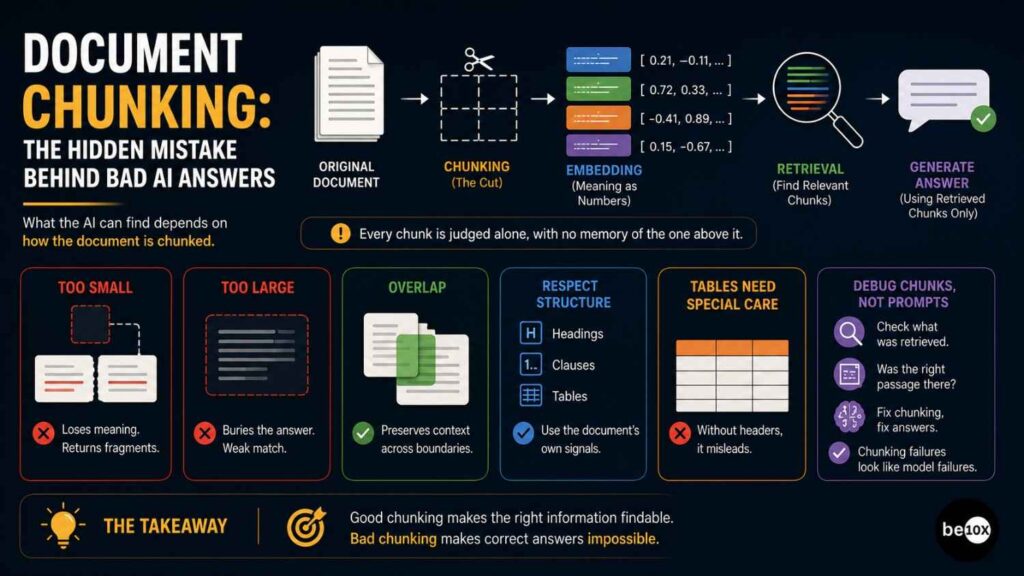
Document chunking is the step that decides what an AI system is capable of finding, and it happens long before anyone types a question. When an assistant built on company files returns an answer that is confidently incomplete, the model is rarely the problem. The split is.
The cut is made before anything becomes searchable
A language model cannot flip through a fifty page policy manual the way a person can. The manual has to be broken into smaller pieces first, and each piece is stored separately so it can be matched against questions that have not been asked yet. Document chunking is that breaking step. Every piece becomes a self contained candidate answer, and nothing outside the retrieved piece reaches the model.
Every chunk is judged alone, with no memory of the one above it
After the split, each piece is converted into a numerical form so its meaning can be compared against the meaning of a question. This is where document chunking turns consequential, because the process that converts meaning into numbers treats each piece in isolation. A chunk carries no awareness of the paragraph that came before it. Any context left behind in the previous piece is simply unavailable at the moment it is needed.
A chunk that is too small loses the sentence that gave it meaning
Splitting aggressively feels safe because small pieces look precise. The failure is subtle. A refund clause that reads “this applies only to purchases made through the enterprise portal” is useless once separated from the clause naming the refund window. Both halves get stored, both can be retrieved, and neither answers the question properly. The system returns a fragment that is technically accurate and practically wrong.
A chunk that is too large buries the thing being searched for
The opposite error is just as common. When a whole chapter becomes one piece, its stored meaning becomes an average of everything inside it, so a narrow question about one clause matches weakly against a piece that is mostly about ten other clauses. Be10X covers the same effect from the retrieval side in its explanation of why AI keeps making things up and what actually fixes it, which notes that oversized pieces degrade retrieval directly. Document chunking has no universally correct size, only a size that suits the kind of question being asked.
Overlap exists because ideas ignore page breaks
Most working systems let consecutive pieces share a small amount of text, so a thought that crosses a boundary survives in at least one complete form. Microsoft’s own guidance on chunking documents for search describes overlap as duplicating a small amount of content into each piece specifically to preserve context. The cost is redundancy and a larger index. The benefit is that the answer stops disappearing at the seams.
Structure already present in the document is free information
Headings, numbered clauses, table rows, and section breaks are the author’s own signals about where one idea ends. Document chunking that respects those boundaries outperforms document chunking that counts characters and cuts, because the author has already done the semantic work. A policy split at its clause numbers behaves far better than the same policy split every thousand characters, and the effort involved is close to identical.
Tables and numbers break the default assumptions
A table separated from its header row becomes a grid of unlabelled figures. A financial statement split mid column produces pieces that retrieve well and mislead completely. Any document where meaning depends on position rather than prose needs its own handling, which is why teams that treat document chunking as a single global setting tend to get accurate answers from their handbooks and quietly wrong ones from their spreadsheets.
The fix is to read the chunks, not to rewrite the prompt
When an AI system misses something obvious, the instinct is to reword the question. The faster diagnostic is to look at what was actually retrieved and ask whether the correct passage was even stored in a findable form. If the passage was cut in half, no amount of prompt refinement will recover it. Document chunking failures masquerade as model failures, and the two get confused constantly because both look identical from the outside.
Where this becomes a practical skill rather than a concept
Document chunking is one of those decisions that stays invisible until a system is live and someone senior asks why the assistant missed a clause that is plainly written in the document. The agents and automation module in be10x’s AI Career Accelerator Program puts learners through an end to end retrieval build, where splitting documents correctly and handling retrieval failures are part of the work rather than a footnote. Seeing a split go wrong on a real document is what makes the principle stick.
