
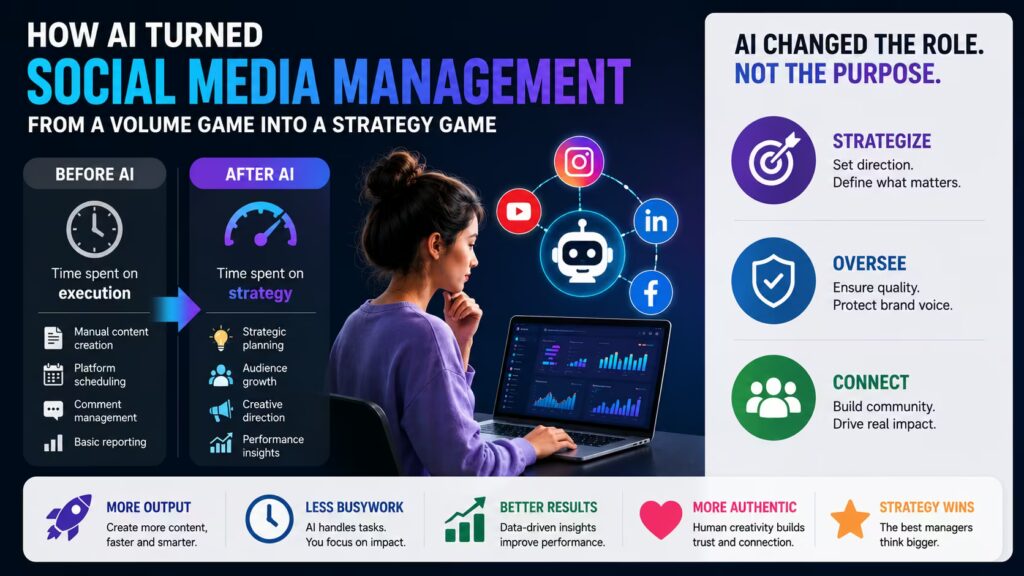
A social media manager producing content for five platforms was once considered highly productive. That same professional equipped with the right AI tools today is running eight platforms, producing significantly more content, and spending far less time on execution than before. The math has changed. And the job has changed with it.
The debate about whether brands should use AI for content creation is over. The vast majority of marketers now use AI tools daily, with most reporting that it speeds up content production and allows them to create significantly more content than before.
This is not a story about AI replacing social media managers. It is a story about what social media managers can now do that was simply not possible before and why the professionals who have built genuine AI fluency are becoming disproportionately valuable to the organizations they work for.
The Content Volume Problem AI Has Solved
Every social media manager knows the feeling. Monday morning, eight platforms to feed, a content calendar that is half-empty, and a brief that keeps changing. The execution work alone writing captions, resizing visuals, adapting tone for each platform, scheduling, responding to comments consumed most of the working week before a single strategic decision was made.
The majority of creators now report creating content faster than ever. Tasks that previously consumed days now take minutes. AI tools handle ideation, first drafts, visual generation, and platform-specific adaptation at a speed that fundamentally changes what one person or a small team can produce.
A single piece of content intelligence a trending topic or a product announcement now gets expressed as an Instagram Reel concept, a YouTube Short outline, and a Reddit discussion post, with each version native to its platform. What once required a content team working across an entire day now happens in a single AI-assisted session.
Companies using agentic AI for social media report significantly higher content output with considerably lower per-post cost compared to fully manual operations. That shift explains why AI adoption in social media has moved from optional to essential faster than almost any other professional domain.
What AI Is Actually Handling Now
AI is now embedded into most aspects of social media marketing especially content creation, optimization, data analytics, and customer service workflows. But understanding specifically where AI is doing the heavy lifting helps social media managers use it more deliberately rather than just more frequently.
Content ideation and trend research is one of the clearest use cases. AI-powered analytics, reporting, and trend research are now the top priorities for social media marketers, followed closely by caption writing and visual creation. AI tools scan platform data in real time, surface emerging topics before they peak, and generate content angles calibrated to what a specific audience is most likely to engage with.
Scheduling and performance optimization have moved from manual to largely automated. AI systems now determine optimal posting times based on historical engagement data, adjust content distribution strategies based on live performance signals, and flag underperforming content early enough to course-correct before it affects broader campaign metrics.
Community management is another area seeing rapid AI integration. AI agents can handle customer inquiries, complaints, and feedback at any time, delivering tailored responses that feel human while providing highly relevant recommendations to individual needs and flagging issues for human escalation when the situation warrants it
The Shift in What Social Media Managers Are Actually Doing
The day-to-day work of content creation, scheduling, and comment management is increasingly handled by AI agents. Human team members now focus on three core areas. Strategic direction deciding what the brand stands for, which audiences to target, and what outcomes matter. Quality oversight reviewing agent output to ensure brand alignment and catching edge cases. And high-stakes decisions that require human judgment and contextual understanding that no AI system currently provides.
For performance marketing, the role of human input is shifting from implementation to strategy, conception, and control. The social media manager who previously spent most of their time on execution is now spending the majority of their time on the decisions that actually drive brand growth which stories to tell, which communities to build, and which moments to show up for authentically.
Marketers are shifting from chasing virality to building purposeful communities, with key strategies including proactive community management, optimizing for social search and answer engine optimization, and using video-first approaches tailored to specific platform behaviors. These are strategic calls that require deep understanding of audience psychology, brand positioning, and platform culture none of which AI can determine on its own.
The Authenticity Paradox That Defines This Moment
There is a tension at the heart of AI-driven social media that every professional needs to understand. AI and algorithms are automating almost every aspect of social media marketing, while users simultaneously crave more authenticity. More content and more technology will not automatically lead to greater impact. Genuine attention is harder to earn than ever.
Brands are increasingly embracing edutainment content that educates while entertaining to satisfy consumer demand for authentic, real-world experiences that feel tangible amid a saturated digital landscape. The brands winning on social media are not the ones producing the most AI-generated content. They are the ones using AI to handle production while investing human creativity and judgment into the stories, perspectives, and community relationships that audiences actually trust.
This is the skill that separates good social media managers from great ones in the AI era. Knowing how to use AI to produce at scale while maintaining the human authenticity that makes content worth following is not a technical capability. It is a creative and strategic one.
What Social Media Managers Need to Build Right Now
The practical starting point for social media professionals is developing working fluency with AI tools across the core functions of the role: content generation and adaptation, scheduling and optimization, social listening and trend research, and performance analytics. Professional adoption is now nearly universal across the industry. The gap is no longer between those who use AI and those who do not. It is between those who use it strategically and those who use it reactively.
Beyond tools, the underlying capability that matters most is the ability to brief AI effectively, maintain a consistent brand voice across AI-assisted content, and catch outputs that are technically correct but tonally wrong for a specific audience or moment. These judgment calls cannot be automated. They are what make a skilled social media manager irreplaceable even as the tools become more capable.
When I went through Be10x’s AI Career Accelerator, one of the things that stood out was how the program approached content and branding not as separate from AI but as something AI fundamentally changes. Learning to use AI for image and video creation, personal branding, and content workflows gave me a practical foundation for understanding how to build AI into a content process rather than using it as an occasional shortcut. For social media professionals looking to close that gap, that kind of structured learning changes how quickly the skills translate into real output.
The Bigger Picture
Social media now reaches billions of users worldwide and functions as a primary layer of the internet, powering thousands of jobs and shaping culture in real time. The scale of what social media managers are responsible for has never been larger, and AI is the only tool that makes managing that scale feasible for small teams.
The social media managers who will define the next phase of the profession are not the ones who resist AI because it feels like a threat to their craft. They are the ones who use AI to handle the volume, protect their time for the creative and strategic decisions that actually require human judgment, and build the kind of authentic community relationships that no algorithm can manufacture.
The output has multiplied. The craft has not disappeared. It has just moved upstream.
Frequently Asked Questions
Will AI replace social media managers?
AI will not replace social media managers but it is automating the execution-heavy parts of the role including content drafting, scheduling, basic community responses, and performance reporting. The strategic, creative, and relationship-building aspects of the role are growing in importance. Professionals who develop AI fluency are becoming significantly more productive and valuable, not redundant.
How are social media managers using AI to increase content output?
Social media managers are using AI to handle content ideation, first-draft writing, platform-specific adaptation, visual generation, optimal scheduling, and performance analysis. A single content idea can now be expressed across multiple platforms in platform-native formats within a single AI-assisted session, compared to what previously required a full day of manual production work.
What AI tools are most useful for social media managers?
The most valuable tools are AI-powered content generation platforms for writing and visual creation, social listening tools that surface trending topics in real time, scheduling platforms with built-in AI optimization for posting times and distribution, and analytics tools that use predictive modeling to forecast content performance before publishing.
How do social media managers maintain authenticity while using AI?
The most effective approach is using AI for production volume while investing human creativity and judgment into the strategic decisions which stories to tell, which communities to build, which brand perspectives to express. AI handles the execution layer. The social media manager determines what is worth saying and ensures that AI-generated content reflects the genuine voice and values of the brand.
What skills make a social media manager valuable in the AI era?
The combination most in demand is strategic content thinking, deep platform and audience knowledge, the ability to brief AI tools effectively and maintain brand voice in AI-assisted output, community building skills, and data literacy for interpreting AI-generated performance insights. These are the capabilities that AI assists but cannot replace.

