For most of the early AI boom, the assumption was simple: bigger is better. The largest models, trained on the most data, with the most parameters, would naturally produce the best results. That assumption drove billions of dollars of investment into models like GPT-4, Claude Opus, and Gemini Ultra — systems so large they require entire data centre clusters just to run.
What Exactly Is a Small Language Model?
A language model, at its core, is a mathematical system trained to understand and generate human language by predicting the most likely next word in a sequence. Both large and small language models share this fundamental architecture. What separates them is scale.
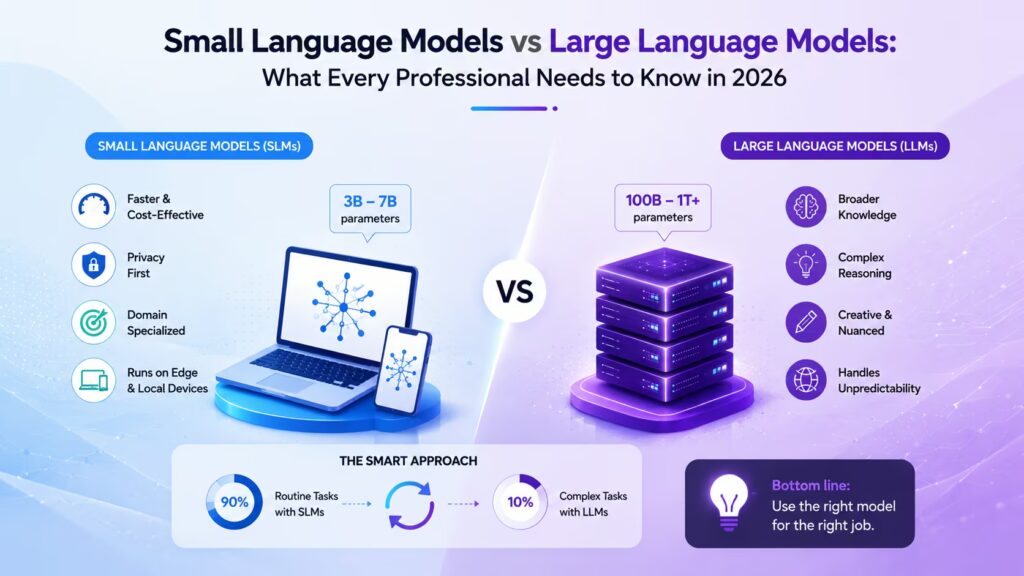
Large language models like GPT-4 operate at over one trillion parameters. Claude Opus runs at hundreds of billions. Even models considered mid-range, like Llama 3.1 70B, are enormous by most practical standards. They are trained on vast, diverse datasets drawn from across the internet, which gives them broad general knowledge and the ability to handle almost any topic with reasonable competence.
Small language models typically sit under ten billion parameters. Models like Microsoft’s Phi-3 Mini at 3.8 billion parameters, Meta’s Llama 3.2 3B, and Mistral 7B are considered leading SLMs in 2026. They are designed to run on edge devices, private servers, or even a powerful laptop, without requiring expensive GPU clusters or cloud API costs measured in thousands of dollars per month.
The critical distinction is not just size. It is what size enables. SLMs are built and fine-tuned for specific domains, which means a 3 billion parameter model trained on customer support conversations will frequently outperform GPT-4 on a company’s specific support queries, while running on hardware the company already owns.
Where Large Language Models Still Win
Large language models remain the clear choice for tasks that demand broad reasoning, deep contextual understanding, and the ability to handle genuinely unpredictable inputs.
Complex analysis and decision support — legal document review, financial modelling, research synthesis, code generation across multiple languages and frameworks — all benefit from the breadth of knowledge that only a large model can carry. Enterprise copilots designed to answer wide-ranging questions from employees across an entire organization need the flexibility that an LLM provides. Long-form content creation, strategic summaries, and knowledge-heavy documentation where nuance and creativity matter are areas where LLMs consistently outperform their smaller counterparts.
The tradeoff is real. LLMs are expensive to run at scale, introduce latency that is noticeable in real-time applications, and raise data privacy concerns because they typically require sending information to external cloud APIs. For many enterprise applications, these tradeoffs are acceptable because the quality of output justifies the cost. For many others, they are not.
Where Small Language Models Are Winning Right Now
The shift happening in 2026 is not that SLMs are replacing LLMs. It is that organizations are discovering entire categories of work where SLMs perform equally well or better, at a fraction of the cost and with significantly better speed and privacy.
Customer support automation is one of the clearest examples. A domain-specific SLM fine-tuned on a company’s product documentation, past support tickets, and resolution workflows will handle the vast majority of inbound queries faster, more accurately, and more consistently than a general-purpose LLM being prompted to behave like a support agent. The narrower scope that might seem like a limitation is actually what makes the SLM more reliable in a defined context.
Data extraction, document summarisation, form validation, and classification tasks are all areas where SLMs excel. These are high-volume, repetitive operations where speed and cost efficiency matter more than creative flexibility. In healthcare, a domain-specific SLM fine-tuned on medical terminology and clinical protocols can generate outputs that are far more accurate than a general model trying to navigate specialized language it was not primarily trained on.
Edge deployment is another area where SLMs have no real competition from large models. Applications that need to run directly on devices, operate in environments with limited connectivity, or process data that cannot leave a secure environment for regulatory reasons all benefit from models compact enough to run locally. LLMs simply cannot operate in these conditions.
The Hybrid Approach That Leading Organizations Are Using
The most sophisticated AI strategies in 2026 are not choosing between SLMs and LLMs. They are using both deliberately, assigning work to whichever model is best suited to handle it.
A common architecture involves a fine-tuned SLM handling the majority of routine, high-volume requests — often around 90 percent of total query volume — while an LLM is called only for the complex, ambiguous cases that fall outside what the smaller model can handle confidently. This approach dramatically reduces infrastructure costs while maintaining quality across the full range of use cases an organization needs to cover.
Model distillation is another technique gaining adoption, where a large language model is used to teach a smaller one by generating training data that the SLM then learns from. The result is a compact model that has absorbed specific reasoning patterns from its larger counterpart without requiring the compute resources to run the original. Quantization and pruning, techniques that compress models by reducing the precision of their parameters, are also enabling teams to shrink production models significantly without proportional drops in performance.
What This Means for Professionals
The practical implication of the SLM vs LLM conversation for working professionals is not about choosing which model to use. Most professionals will not be selecting models directly. The implication is about understanding why different AI tools behave differently, when to trust AI output fully and when to apply more scrutiny, and how to structure AI workflows that are efficient rather than defaulting to the most powerful and expensive option for every task.
Understanding the difference between a general-purpose AI assistant and a purpose-built AI tool fine-tuned for a specific function helps professionals make better decisions about which tools to use, how to prompt them effectively, and what limitations to account for. A professional using a specialized AI tool for financial analysis is working with a fundamentally different system than one using a general chat interface, and the appropriate level of trust in their outputs differs accordingly.
Programs like Be10x’s AI Career Accelerator are designed to build this kind of working AI literacy alongside practical tool skills, helping professionals understand not just how to use AI tools but why they work the way they do. In a landscape where AI deployment decisions are increasingly part of every professional’s role, that conceptual foundation makes a meaningful difference.
The Bigger Shift
The early days of AI adoption were defined by access. Getting access to a powerful model at all was the challenge. In 2026, the challenge has shifted. Most organizations have access. The question now is which model to use, for which task, at what cost, with what privacy constraints, and how to know when AI output should be trusted.
Bigger is not always better. The right model is the one that solves the right problem efficiently. Understanding that distinction is what separates organizations and professionals who use AI strategically from those who are simply using it.
Frequently Asked Questions
What is the main difference between a small language model and a large language model? The primary difference is scale and specialization. Large language models are trained on enormous, diverse datasets and can handle almost any task with broad competence. Small language models are trained at a smaller scale, often fine-tuned on domain-specific data, and excel at defined tasks within their area of specialization. SLMs are faster, cheaper to run, and more privacy-friendly, while LLMs offer broader reasoning and flexibility.
Can a small language model outperform a large language model?
Yes, in specific contexts. A small language model fine-tuned on relevant domain data will frequently outperform a large general-purpose model on tasks within that domain. A customer support SLM trained on a company’s specific products and policies, for example, will typically produce more accurate and consistent responses than a large model being prompted to act as a support agent without domain-specific training.
Which industries are adopting small language models the fastest?
Healthcare, financial services, legal, and customer support are among the fastest adopters of domain-specific SLMs. These sectors deal with specialized terminology, strict data privacy requirements, and high-volume repetitive tasks — all conditions where SLMs offer clear advantages over general-purpose large models.
Are small language models more private than large language models?
Generally yes. Because SLMs can run locally on private servers or edge devices without sending data to external cloud APIs, they are better suited for use cases where data privacy and regulatory compliance are priorities. Many enterprises in regulated industries are adopting SLMs specifically because they can keep sensitive data within their own infrastructure.
Do professionals need to understand the difference between SLMs and LLMs?
Yes, increasingly so. As AI tools become embedded in everyday professional workflows, understanding why different tools behave differently and what their limitations are —helps professionals use them more effectively, apply appropriate levels of scrutiny to AI-generated outputs, and make better decisions about which tools to use for which tasks.
