
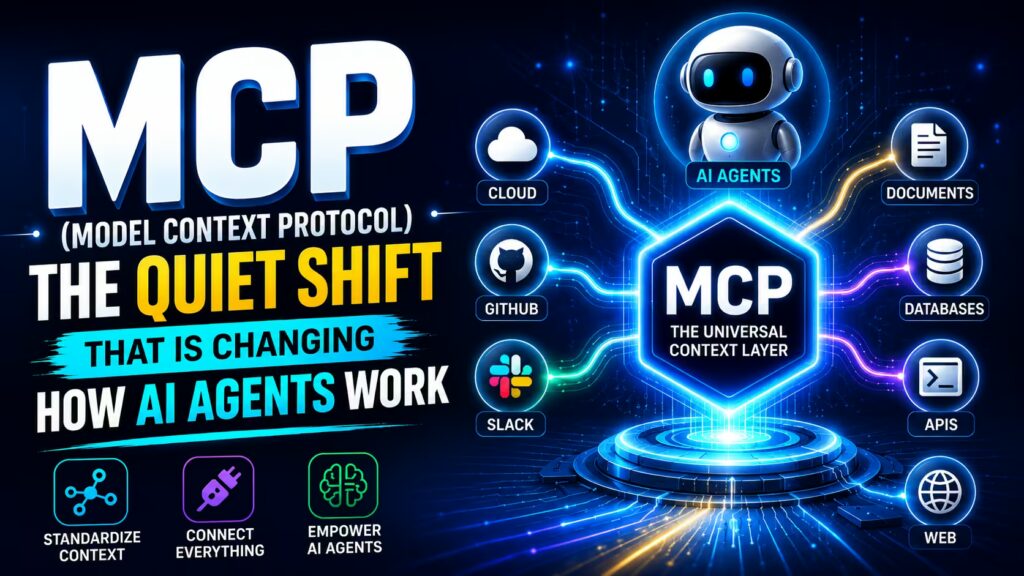
Most people building with AI have not heard of MCP yet. By the end of this year, they will not be able to ignore it.
DIRECT ANSWER
Model Context Protocol (MCP) is an open standard introduced by Anthropic in late 2024 that allows AI agents to connect to external tools, databases, and services through a single standardised interface. Instead of building a separate custom integration for every tool an AI needs to access, MCP provides one consistent protocol that any AI model and any tool can speak. As of 2026, MCP is supported by Claude, and is being adopted across major AI development frameworks.
What MCP actually is, in plain language
Before MCP, connecting an AI agent to an external tool meant writing custom code for every single connection. Want your agent to read a Google Doc? Write an integration. Want it to check a calendar? Write another one. Want it to pull from a database? Another one. Each integration was its own project, its own maintenance burden, its own potential point of failure.
MCP changes this by creating a shared language. Think of it like a universal power adapter. You plug in once and it works with everything that supports the standard. An AI model that supports MCP can talk to any tool that also supports MCP, without anyone writing custom glue code in between.
Anthropic published MCP as an open standard in November 2024. Since then it has been picked up by a growing number of AI tools and frameworks. By early 2026, MCP support has become a standard feature request when teams are evaluating AI development infrastructure.
Why this matters for people who are not engineers
The practical impact of MCP is not just for developers. It changes what is possible for anyone building AI workflows, including non-technical professionals.
Before MCP, building an AI agent that could read your emails, check your calendar, update a spreadsheet, and send a summary to a Slack channel required significant technical work to string those four integrations together. With MCP, if all four tools expose an MCP server, an AI agent can connect to all of them through the same interface without custom integration work for each.
This is already showing up in tools like n8n, which has added MCP support. A workflow that would have required several manual connection steps can now be set up through a single MCP node. For anyone building automation workflows at work, this is a real reduction in friction.
The architecture in simple terms
MCP has two sides. The MCP server is the tool or data source that wants to be accessible. The MCP client is the AI model or agent that wants to access it. When both sides speak MCP, the connection is straightforward.
What an MCP server can expose falls into three categories. Resources are data the AI can read, like files, database records, or API responses. Tools are actions the AI can take, like sending an email or updating a record. Prompts are pre-built templates that help the AI use the tool correctly.
The result is that a developer building an MCP server for their product makes it accessible to every AI agent that supports MCP, without needing to know which AI models their users are running. And a team building an AI agent can connect to every MCP server without writing custom integrations for each one.
Where MCP stands in 2026
Adoption has been faster than most people expected. Claude supports MCP natively. A growing library of MCP servers exists for common tools including Google Drive, GitHub, Slack, databases, and various APIs. The n8n automation platform added MCP support, making it accessible to the no-code and low-code automation community.
The honest caveat is that MCP is still maturing. Not every tool has an MCP server yet, and the quality of existing MCP servers varies. Teams adopting MCP in 2026 are early movers, and early movers accept some roughness in exchange for being ahead of the curve when the standard matures fully.
But the direction is clear. MCP is becoming infrastructure. The same way HTTP became the protocol that made the web possible, MCP is positioning itself as the protocol that makes AI agent interoperability possible. Teams that understand it now will have a meaningful head start.
What this means for your AI skills
Understanding MCP does not require being a software engineer. What it requires is understanding what protocols are, why standardisation matters, and how to think about tool connectivity when designing AI workflows.
These are the kinds of concepts covered in the AI Agents and Autonomous Systems module at Be10x, where learners build actual n8n workflows that use MCP connections as part of real agent architectures. The shift from knowing AI exists to knowing how AI infrastructure fits together is the shift that separates people who can talk about agents from people who can build them.
MCP is one of those concepts that sounds technical until you understand it, and then it sounds obvious. That transition, from confused to capable, is exactly where most AI upskilling needs to happen in 2026.
Frequently Asked Questions
What does MCP stand for?
MCP stands for Model Context Protocol. It is an open standard published by Anthropic in November 2024 that defines how AI models and external tools communicate with each other.
Who created MCP?
MCP was introduced by Anthropic, the AI safety company behind Claude. It was released as an open standard, meaning any organisation can implement it without licensing fees.
Is MCP only for Claude?
No. Although Anthropic created MCP, it is an open standard. Any AI model or tool can implement MCP support. As of 2026, adoption is growing across multiple AI frameworks and platforms.
Do I need to be a developer to use MCP?
Not necessarily. Tools like n8n have integrated MCP support into their visual workflow builder, making it accessible to non-technical users. Understanding what MCP does and how to configure it is within reach for anyone working with AI automation tools.
Where can I learn to build with MCP?
The AI Agents and Autonomous Systems module in the Be10x AI Career Accelerator covers MCP as part of hands-on agent workflow building. Anthropic also maintains documentation at docs.anthropic.com.

