
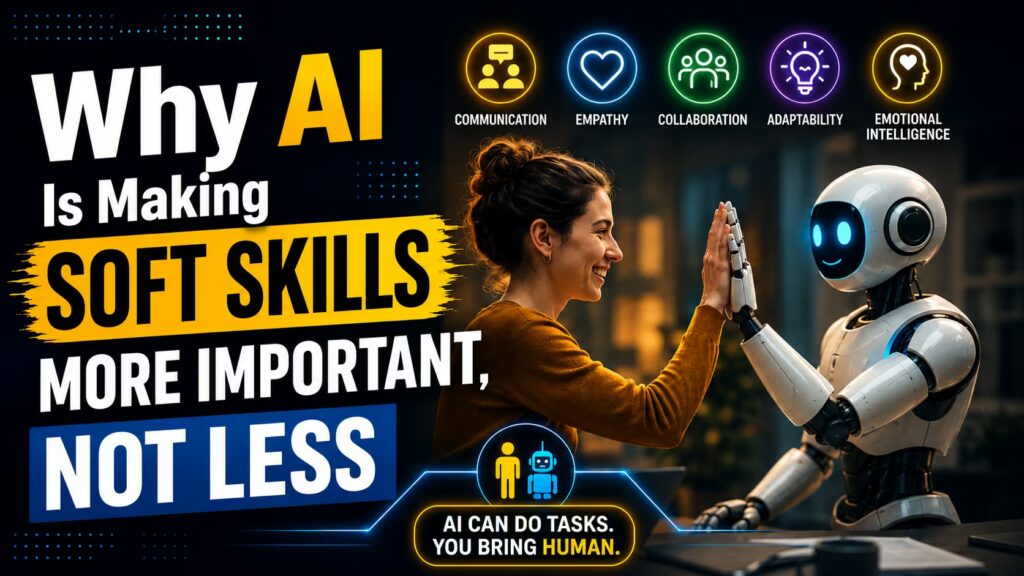
Everyone expected AI to replace human skills. What actually happened is more interesting.
DIRECT ANSWER
As AI handles more routine and technical tasks in 2026, the skills that remain distinctly human — clear communication, critical thinking, judgment under ambiguity, and the ability to direct and evaluate AI output — have become more valuable, not less. Organisations are finding that the people getting the most from AI tools are not necessarily the most technical. They are the ones who can think clearly, communicate precisely, and make sound decisions about what AI produces.
The prediction that did not come true
For the last several years the dominant narrative around AI and work was one of replacement. Which jobs would survive, which would not, which skills were safe. The assumption underneath most of these conversations was that AI would eliminate human skills from the equation as it got better.
What actually happened in 2026 is more nuanced. AI got better at the parts of work that are structured, repetitive, and rule-based. First drafts, data formatting, routine analysis, code generation for standard patterns. These tasks are now largely AI-assisted or AI-handled in organisations that have invested in the tooling.
What emerged more visibly as AI took over those tasks is how much of the remaining work depends entirely on things AI cannot reliably do. Knowing what to build and why. Evaluating whether an output is actually good. Communicating clearly enough that the AI produces something useful in the first place. Managing people who are using AI tools. Making decisions when the data is ambiguous.
These are soft skills. And in 2026 they are harder to find than ever.
Why prompting is actually a communication skill
One of the clearest examples of this shift is what good prompting actually requires. On the surface it looks technical. There are frameworks, there is structure, there are things that work and things that do not.
But when you dig into why some people consistently get better outputs from AI than others, the answer is almost never technical knowledge. It is clarity of thought. The ability to articulate what you actually want, for whom, in what format, with what constraints. These are communication skills that most people were never formally taught because until recently there was no tool that made the gap between clear and unclear thinking so immediately visible.
The CoStar prompting framework taught in many structured AI programs, Context, Objective, Style, Tone, Audience, Response, is really a framework for clear communication. The AI just makes the result of unclear communication immediately obvious in a way that a human collaborator often did not.
Judgment is becoming the scarce resource
AI in 2026 produces a lot. Reports, analyses, code, designs, plans. The volume of output available to any team has increased significantly. What has not increased is the capacity to evaluate that output and decide what to do with it.
This is where judgment comes in. Not every AI output is correct. Not every AI suggestion is the right one for a given context. The person who can read an AI-generated analysis and identify where the reasoning is weak, where the assumptions are wrong, or where the conclusion does not follow is more valuable now than before AI existed. Because there is now far more AI output that needs to be evaluated.
Judgment is difficult to teach directly. It develops through experience, exposure, and the practice of making decisions and reflecting on them. But the organisations building AI-augmented teams are actively looking for people who have it. It is showing up in job descriptions in 2026 more visibly than before.
Leadership and communication in an AI-assisted team
Managing a team that uses AI tools is different from managing a team that does not. The inputs are different, the outputs are different, and the failure modes are different. A manager who does not understand what their team is using AI for cannot effectively evaluate the work, cannot catch errors that come from AI limitations, and cannot coach their team on how to use the tools well.
This is creating demand for a specific kind of leadership capability. Not technical expertise in AI, but enough fluency to engage with what the team is doing, ask the right questions about how AI was used in a given output, and make informed decisions about where human judgment needs to override what the tool produced.
Be10x’s AI Career Accelerator addresses this directly in the AI in Business Communication and Team Leadership session, which covers how to communicate, lead, and make decisions in an environment where AI is a regular part of the workflow. This is not a soft topic. It is one of the more practically urgent things a working professional can develop in 2026.
What this means for how you should be developing yourself
The mistake most people make when thinking about AI and career development is treating it as purely a technical upskilling problem. Learn the tools, learn the workflows, stay current with what is new. That is necessary but not sufficient.
The professionals who will be most valuable over the next several years are the ones developing both. The technical fluency to work with AI tools effectively and the human skills to do the things AI cannot. Clear thinking, precise communication, sound judgment, the ability to lead people through ambiguity.
These skills compound differently than technical skills. A person with strong judgment and clear communication who also understands AI tools is significantly more capable than someone with only one or the other. The combination is what the market is actually short of in 2026.
Frequently Asked Questions
Will AI replace soft skills?
No. As of 2026, AI has become effective at structured, repetitive, and rule-based work, but the skills that remain most valuable are those AI cannot reliably replicate: clear communication, critical judgment, leadership, and decision-making under ambiguity. These skills have become more important as AI handles more of the routine work.
What soft skills matter most in an AI-augmented workplace?
Clear communication, critical thinking, judgment, and the ability to evaluate AI output are among the most valuable. The ability to lead teams that use AI tools and make decisions about when to trust AI and when to override it is also increasingly important at the management level.
Is prompting a soft skill or a technical skill?
Prompting is primarily a communication skill. The ability to articulate clearly what you want, for whom, in what format, with what constraints, is what separates people who get consistently useful AI output from those who get inconsistent results. Technical frameworks like CoStar help structure this, but the underlying skill is clarity of thought.
How is AI changing leadership requirements?
Leaders managing AI-assisted teams need enough fluency with AI tools to evaluate the work their team produces, identify where AI limitations might have introduced errors, and coach team members on effective AI use. This requires neither deep technical expertise nor avoidance of AI, but engaged familiarity with how the tools work and where they fall short.
Where can I develop both AI and communication skills together?
Be10x’s AI Career Accelerator covers both within the same program. Technical modules on prompt engineering, automation, and AI agents run alongside sessions on business communication, leadership, and career readiness, reflecting the view that both are necessary for professionals working in AI-augmented environments in 2026.

