
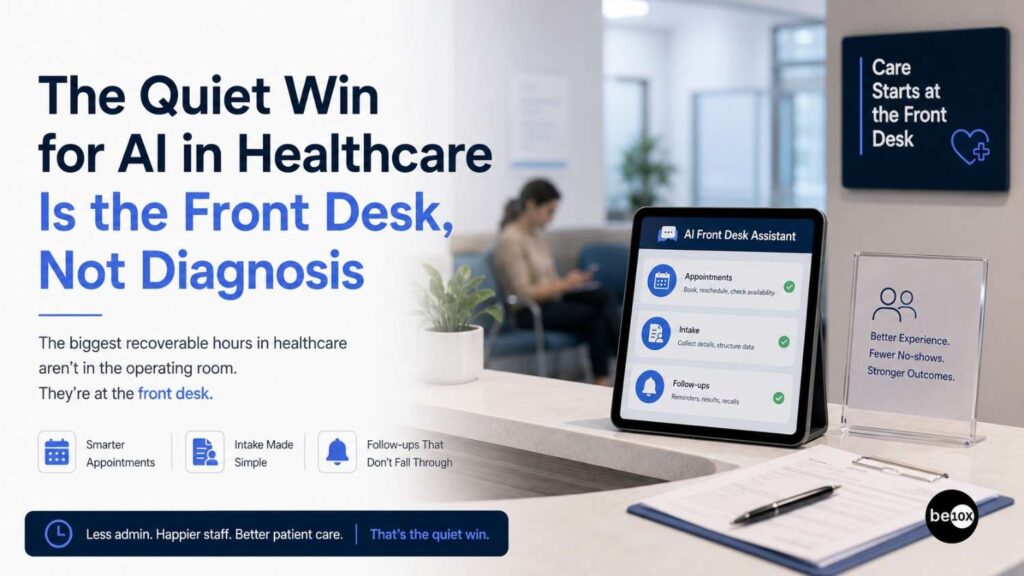
AI in healthcare is argued about almost entirely at the clinical end. Can a model read a scan, flag a risk score, suggest a differential. Those are serious questions with serious answers, and they absorb most of the attention paid to the sector. Meanwhile the recoverable hours in a clinic or a mid-sized hospital sit somewhere far less interesting: the front desk, where appointments churn, intake forms get filled twice, and follow-ups depend on someone remembering to call. The unglamorous half of AI in healthcare is where the arithmetic already works.
Where the hours actually leak
Three loads dominate front-office work, and they are rarely the ones counted when a hospital budgets for AI in healthcare. Appointment churn is the first, covering the phone queue, the reschedules, the no-shows nobody chased, and the empty slot that could have been filled by the patient who was told to wait ten days. Intake is the second, where the same details are collected on paper, read back over a counter, and typed into a system, with legibility and completeness as permanent problems. Follow-up is the third, covering test result communication, review appointments after a procedure, and recall for chronic patients who quietly stop showing up. None of it requires clinical judgment. All of it consumes staff who are also managing a waiting room.
The approval bar is not the same on both sides
Anything touching diagnosis carries validation requirements, liability exposure, and an obligation to explain how the output was produced. That burden is appropriate, and it is also why clinical projects move slowly and need specialist supervision. Reminding a patient about a Thursday appointment carries none of it. The failure cases are asymmetric in the same way: a reminder that goes to the wrong number is embarrassing and recoverable, while a missed clinical finding is neither. This asymmetry, more than any technical difference, explains why administrative applications of AI in healthcare reach working deployment while clinical pilots are still gathering evidence.
Appointment churn is a repetition problem
Reception is the least glamorous candidate for AI in healthcare and the most obvious one, because the same handful of questions arrives there in enormous volume. What time is my appointment, can it be moved, does the doctor sit on Saturday, do you take this insurance, where do I send the prescription. High-volume and well-defined is exactly the profile that automation suits, and Be10X’s checklist on the signs a manual task should be an AI agent instead describes it precisely: a process explained to new staff more than a couple of times, requiring two or three systems to be checked before anyone can answer. Reception work fails almost every test for keeping a task manual.
Intake is a structuring problem, not a writing one
The value of automating intake is not that a form gets typed faster, and this is the part of AI in healthcare that compounds quietly. It is that unstructured description becomes structured record. A patient writing about their symptoms in their own words, in whichever language comes naturally, can be turned into consistent fields that a doctor scans in seconds and a records system can actually search later. The consultation then starts from history rather than from data entry. A verification step stays in place, because a member of staff confirming what was captured costs a fraction of the time that transcribing it from scratch does.
Follow-up is where money and outcomes overlap
Recall is the load most often abandoned when a clinic gets busy, and it is the one where neglect shows up in both directions. Patients who never return for a review are worse off clinically, and the practice loses revenue it had already earned the right to. Reminders, result notifications, and recall sequences are repetitive, scheduled, and low-judgment. They are also the part of AI in healthcare that a small practice can implement without a technology partner or a procurement cycle.
What this does not mean
None of this argues that clinical AI in healthcare is a distraction, and imaging support in particular has genuine evidence behind it. The argument is about sequence, not merit: administrative work pays back sooner, cheaper, and with less risk. Two cautions belong here. Administrative data is still patient data, so consent, storage, and access rules apply to a reminder system exactly as they apply to a records system. And someone has to own the exceptions, because the calls that fall outside the script are the ones where the practice’s reputation actually gets decided.
Where to start
The honest starting point for AI in healthcare is one queue, not a platform. Whichever question reception answers most often, in the highest volume, with the least variation, is the candidate. Be10X makes the same case for any function in the questions people actually ask before using AI at work, where the advice is to pick the most repetitive task rather than the most impressive one and build the smallest version that handles it. Applied to a clinic, that usually means appointment confirmation before anything else.
Knowing which task to hand over first is a more transferable skill than knowing any single tool, and it is what Be10X’s AI tools workshop is structured around for professionals across operations-heavy functions, healthcare included.
