
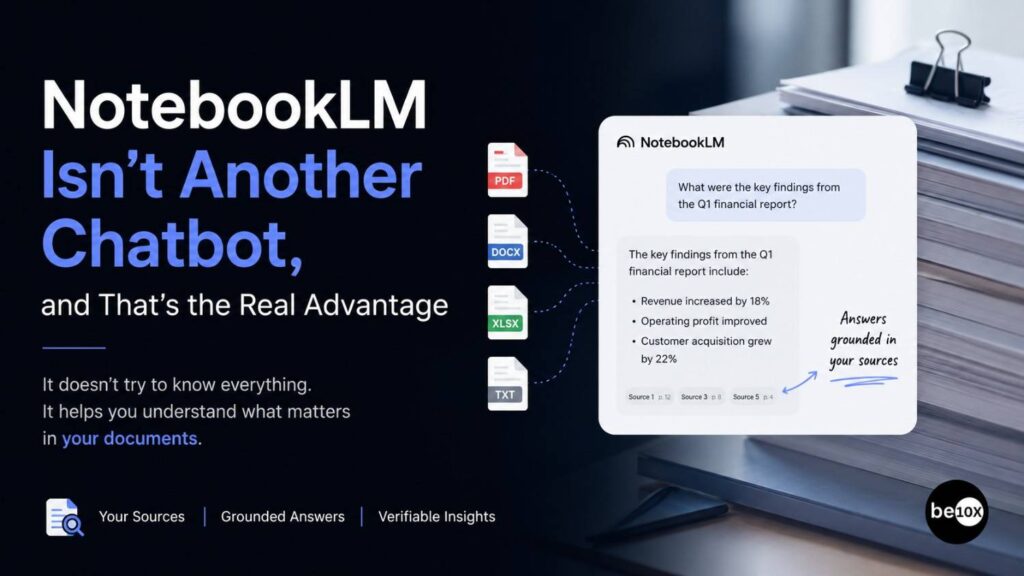
NotebookLM gets filed in the same mental drawer as every other AI tool, a box where a question goes in and a paragraph comes out. That filing error is the main reason professionals open it once, conclude it is a slower version of the assistant they already use, and never go back. The product runs on an inverted premise, and the inversion is the entire point.
The difference is where the answer comes from
A general-purpose assistant answers from everything absorbed during training, plus whatever it can pull off the open web. NotebookLM answers only from the sources placed inside a notebook: uploaded reports, contracts, slide decks, transcripts, pasted text, links. Ask it something the sources do not cover, and it says the sources do not cover it instead of assembling a fluent paragraph out of general knowledge. That restriction reads as a weakness for about ten minutes, and then it becomes the reason the output can be handed to someone else.
The mechanism underneath is worth understanding on its own: Be10X’s explained on why AI keeps making things up walks through how retrieving relevant passages first changes what a model has in front of it before it writes a single word.
A wrong answer looks different in a grounded tool
With open generation, a wrong answer arrives well-structured, confident, and unattributed. Nothing about its surface distinguishes it from a right one, which is why verification means re-reading the source material anyway. In NotebookLM, claims carry inline citations back to the specific passage they came from, so checking is a click rather than a re-read. More usefully, a gap in the source pile shows up as an absence, because the tool declines, instead of being quietly filled with invention. Reviewing shifts from trusting prose to auditing pointers, which is a far cheaper form of diligence.
Why report-heavy roles get the most out of it
Some work is mostly composition: drafts, emails, campaign copy, first-pass code. Other work is mostly interrogation of a fixed pile of documents. What did the vendor actually commit to across three amendments. Which recommendation from the last audit was never closed. What did sixty interview transcripts say about pricing that nobody wrote into the summary.
Analysts, consultants, compliance staff, programme managers, and operations leads spend their days there, and their answers get challenged in meetings. For that work, a citation trail is not a nice-to-have feature but the deliverable itself, which is why NotebookLM tends to earn a permanent place in document-heavy roles while sitting unused in writing-heavy ones.
The chatbot label hides a real choice
Calling every AI tool a chatbot flattens the distinctions that decide which tool suits which task, and the cost of that flattening shows up as wasted effort. Be10X covers a parallel version of the same mistake in the difference between AI agents and AI chatbots.
One is built to answer, the other to act, and treating them as interchangeable leads teams to the wrong build. The grounded-versus-open distinction works the same way. Open generation suits exploration, ideation, and anything where outside knowledge is the value. Grounded answering suits verification, synthesis, and anything where outside knowledge is contamination, and NotebookLM sits firmly on that second side of the line.
What NotebookLM does not fix
A notebook is only as good as what goes into it. Feed it an outdated policy document and NotebookLM will answer accurately from an outdated policy document, with citations, which is more dangerous than an obvious error. The tool also cannot reach for a market benchmark or an industry norm that nobody uploaded, so questions requiring outside context need a different tool entirely. Most of the real skill moves upstream: deciding which sources belong in a notebook, keeping them current, and noticing when a question has quietly stepped outside their boundary.
One test worth running
The fastest way to feel the difference is to use documents already known well. A closed project’s post-mortem, a signed contract, a set of survey responses, anything where the answers are already sitting in someone’s head. Load them into a single NotebookLM notebook, ask five questions with known answers, then grade the citations rather than the prose. Where the pointers land on the right passage, that category of question is safe to delegate. Where they drift, the pile needs better structure, not a better prompt.
Being able to match a tool’s design to the shape of the task is becoming more valuable than knowing any single tool deeply, and it is the habit Be10X’s AI tools workshop is built around, working through where grounded tools, open assistants, and automation each actually belong in a professional’s week.
