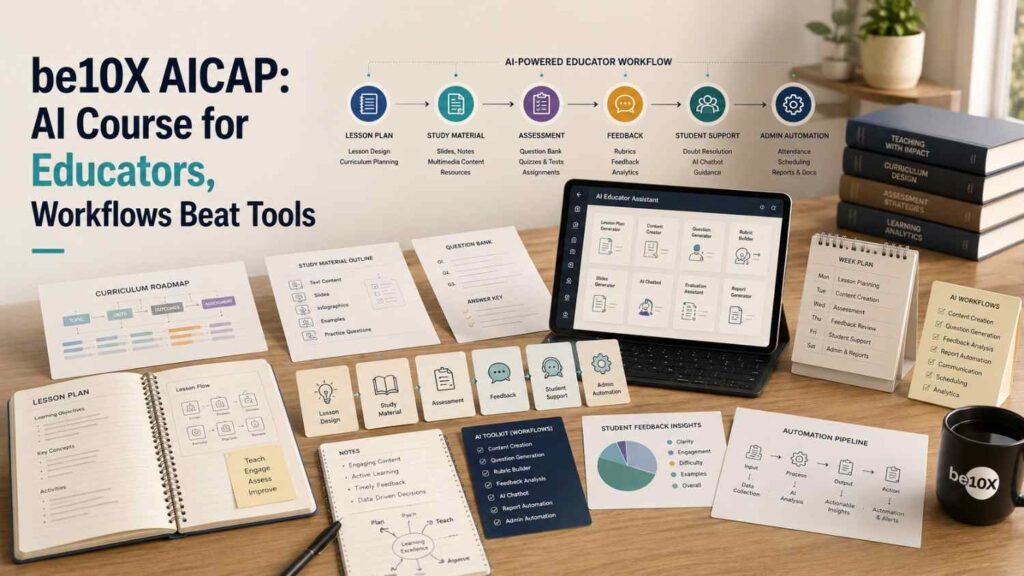
be10X AICAP treats an AI course for educators as a teaching problem rather than a software problem, and that framing is where most listings go wrong. Most of them are general AI courses with one teaching example bolted on at the end. That gap matters, because the work a teacher does is not the work a marketer or an analyst does. Lesson design, study material, assessment, feedback and classroom administration each carry their own bottleneck, and a tour of ten popular tools does not touch any of them.
Teaching is the workflow AI reshapes fastest
UNESCO’s AI competency framework for teachers sets out fifteen competencies across five dimensions, arranged in three progression levels that move from acquiring awareness to creating new practice. Only one of those five dimensions covers AI tools. The rest deal with mindset, ethics, pedagogy and a teacher’s own professional learning. An AI course for educators that skips those four is a software demo, and software demos age badly.
Lesson planning shifts from building to reviewing
The old sequence was research a topic, structure a syllabus, sequence the units, then break each session down by hand, repeated for every new batch. With a properly designed workflow, the first draft of a curriculum outline and a session-wise roadmap arrives in minutes, and the educator spends time on judgement instead of typing. Days of planning compress into an afternoon of review. This is the single change most teachers feel first, and it is why an AI course for educators should begin with planning rather than with prompt tricks.
Study material stops being a weekend job
Slides, notes, worksheets and question banks are formatting work as much as thinking work. Formatting is exactly what generative tools handle well. A useful AI course for educators covers generating structured slide decks from a topic outline, turning those slides into student notes at two different reading levels, and building question papers with answer keys and marking schemes attached. The skill being taught is not generation. It is verification, because a paper with a weak distractor or a wrong key does more damage than no paper at all.
Interactive formats replace static decks
Slides, PDFs and a linked video used to be the ceiling for anything a teacher could produce alone. Avatar-based video lectures, audio explanations built from existing notes, and a doubt-solving assistant trained on the teacher’s own course material now sit within reach of one person with no camera and no editing team. Format choice belongs early in an AI course for educators, because a podcast, an avatar lecture and a chatbot solve different problems.
Evaluation is where the hours actually are
A teacher with a hundred submissions loses a weekend to grading and still struggles to write feedback specific enough to be useful. Structured evaluation workflows change the shape of that task. Responses get scored against a rubric the teacher defines, individual feedback gets drafted per student, and a performance tracker flags who is falling behind before the next assessment rather than after it. The teacher still owns the marks. What changes is that the review is a few focused hours instead of two lost days. Any AI course for educators worth its fee treats evaluation as its heaviest module rather than a footnote.
Administration is automation work, not teaching work
Attendance, timetables, exam scheduling, plagiarism checks and student notices are the tasks with the least to do with teaching and the largest claim on a working day. These are automation problems, and be10X’s guide to the five signs a manual task should be an agent instead supplies the filter to apply before building anything, since a process explained three times over, or one that needs two or three places checked before a decision, describes classroom administration almost exactly. A serious AI course for educators teaches these as automation, using workflow tools rather than a chat window, so the process runs without anyone remembering to trigger it.
Generalist skills come before specialist ones
The sequencing question decides whether any of this sticks. Foundations first, meaning prompting that produces usable output, document and spreadsheet work, and one automation platform. Specialisation second, meaning course design, assessments, an online presence and revenue models built on teaching expertise. Reversing that order is the most common failure, and it is the fastest way to tell a serious AI course for educators from a repackaged tool listing. be10X argues the same point about sequencing in why tasks beat tutorials for AI agent skills, where specifying the job precisely has to come before any framework or library, and that logic transfers to a teaching context without much translation.
The output that matters is a portfolio, not a certificate
Certificates confirm attendance. A recruiter, a school leadership team or a paying student responds to something that works. That is why an AI course for educators should end in build work, where learners pick a real problem from their own teaching context and ship a solution, whether that is a question-generation workflow, a course chatbot or a learning portal built without code. The finished artefact is what gets shown in an interview or a proposal.
The educator track inside the be10X AI Career Accelerator Program is structured on exactly this logic, moving from generalist foundations through teaching-specific specialisation into a capstone build, taught on weekends by practitioners rather than through recorded theory. Anyone weighing up the best AI course for a teaching career should judge it on that sequence, and on whether the projects leave them with something to show.

