
Semantic search and keyword search get treated as two names for the same feature, and that single assumption explains a large share of internal AI tools that look impressive in a demo and disappoint in daily use. A team connects an assistant to a document folder, someone asks a reasonable question, and the tool returns nothing useful. The model is blamed. The retrieval method is almost always the real cause.
The stakes are ordinary career stakes rather than engineering ones. PwC’s AI Jobs Barometer, cited in a feature on how four in five professionals will need to work with AI, found that the skills employers want for AI-exposed roles are shifting roughly two thirds faster than in other occupations. Knowing which kind of search a task needs is one of those shifting skills, and it is the kind that gets exercised in a requirements meeting rather than in code.
What keyword search actually does
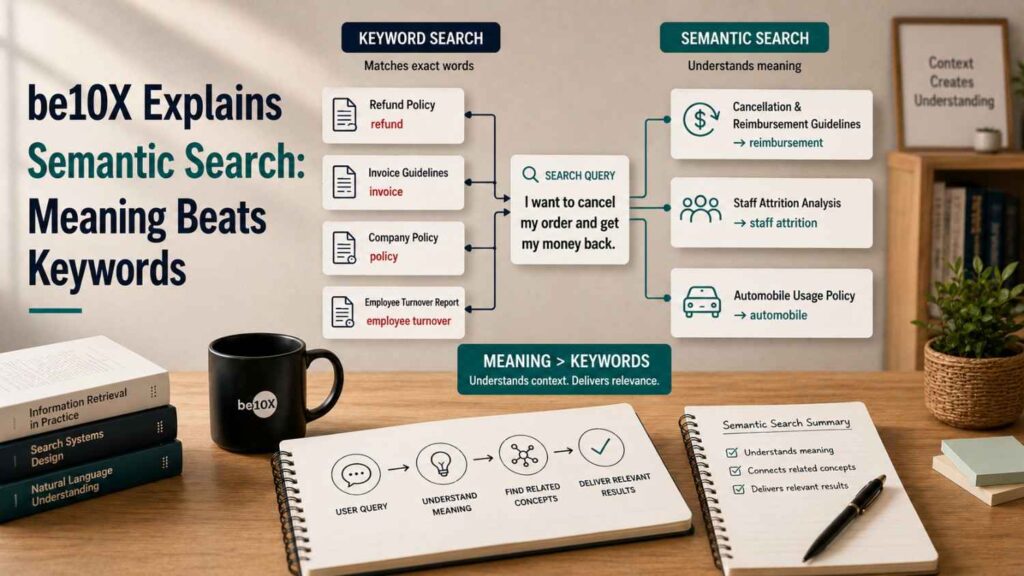
Keyword search matches strings. A query for “refund policy” finds documents containing the words refund and policy, ranks them by how often and how prominently those words appear, and returns the list. The method is fast, cheap, and completely predictable, which is exactly why it has run search boxes for decades. Its limitation is equally simple. A policy document titled “Cancellation and Reimbursement Guidelines” contains neither query word, so a keyword system cannot see it at all. The document exists, the answer sits inside it, and the search returns nothing.
What semantic search actually does
Semantic search matches meaning. Each document is converted into a numeric representation that positions it by what it is about rather than which words it contains, and the query is converted the same way. Retrieval then becomes a question of proximity, so the cancellation document surfaces for a refund query because reimbursement and refund sit close together in that space. The mechanism doing that positioning is explained in full in be10X’s piece on how AI actually understands language.
The gap this produces is measurable rather than theoretical. Research that established dense retrieval as a practical method reported accuracy gains of nine to nineteen points over a strong keyword baseline, and numbers that size do not come from a better model. They come from a different way of deciding what counts as a match.
Semantic search carries a real cost. It takes longer to set up, costs more to run, and cannot explain its own ranking in a way a non-technical stakeholder finds satisfying. Keyword search can always be audited by reading the query back.
Where the difference shows up at work
The semantic search question matters most in three situations that professionals hit constantly. Support teams have customers who describe problems in their own vocabulary rather than the vocabulary of the help centre, which is a semantic problem. Legal and compliance teams need the exact clause reference and nothing adjacent to it, which is a keyword problem. Sales teams searching call notes for a competitor name want every literal mention, and a semantic system that helpfully returns similar competitors has made the list less useful, not more.
Choosing badly produces two distinct failure shapes worth recognising. Keyword search on a meaning question returns an empty result, which at least announces itself. Semantic search on a precision question returns something plausible and slightly wrong, which does not.
Testing whether a tool runs semantic search or plain keyword matching takes about a minute and requires no technical access. Someone runs a query using a word that appears nowhere in the source documents but means the same thing as a word that does, such as asking about staff attrition when every document says employee turnover. A keyword system returns nothing. A working semantic search setup returns the turnover documents. The reverse test is just as quick, since searching for an exact invoice number that a semantic system paraphrases into similar numbers reveals the opposite weakness immediately.
Why the answer is usually both
Mature setups run hybrid retrieval, sending the query through both methods and merging the results, because the two fail in opposite directions. Product codes, invoice numbers, clause identifiers and proper nouns need literal matching. Questions phrased in ordinary language need semantic matching. A single query often contains both, as with a request for the warranty terms on a specific model number, where the model number must match exactly and the warranty language must match loosely.
One caveat is worth stating plainly. Semantic search only retrieves the units it was given, so a system that embedded badly split or inconsistently worded documents will return confident, well-ranked fragments that answer nothing. be10X treats that upstream failure as a core limitation in its explainer on RAG and what it does not fix, and the two problems are frequently mistaken for each other.
The skill hiding inside this choice
Nobody expects a marketer or an operations lead to build a retrieval pipeline. The valuable skill is narrower and more transferable, which is the ability to look at a search request and name which kind of matching it needs before anything gets built. That judgement is what separates a professional who can brief a technical team properly from one who ends up approving a tool that answers the wrong class of question.
Anyone weighing up the best AI course for building this kind of practical judgement will find retrieval design treated as a working skill rather than a lecture topic inside be10X’s AI Career Accelerator Program, where professionals build and break small retrieval setups instead of reading about them. A wider read on the top AI courses in India for students and freshers is useful for anyone comparing options first. Registrations for the introductory AI Tools Workshop are open at be10x.in
