The best AI course for a working professional is almost never the one with the longest syllabus, and the search usually goes wrong at that first step. Someone hunting for the best AI course opens six tabs, compares module lists, notices they all contain prompt engineering, agents, automation and a certificate, and picks on price or brand recall. Every option looks defensible under that test, which is exactly why the test is useless.
A better approach is to judge on what a course does to a learner rather than what it contains. Forbes India coverage of why top performers are trading traditional experience for be10x workflows explains why that framing matters, since employers have started paying for demonstrated capability rather than for attendance or years served. Four questions separate the courses that produce that capability from the ones that produce a folder of notes.
Does it hold you to a schedule
Self-paced is the default format and the reason most AI learning ends unfinished. A course with no fixed date competes with work and family, and it loses quietly rather than dramatically.
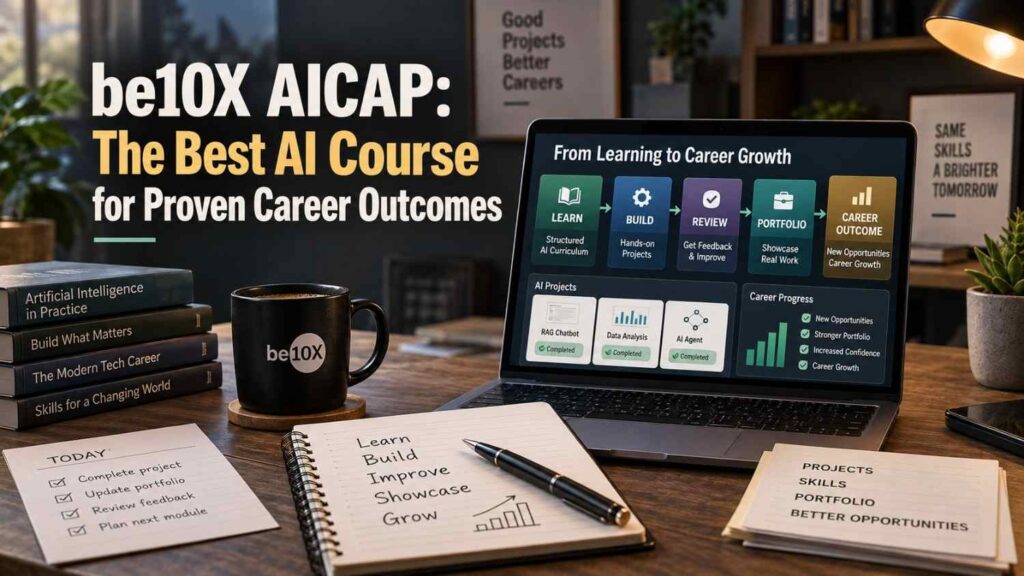
This is the first thing to check when shortlisting the best AI course. AICAP, the AI Career Accelerator Program from be10X, runs live weekend sessions with attendance tracked and recordings deliberately not counting towards it, which converts good intentions into a calendar commitment. Whether or not that suits a given learner, it is a real answer to the question, and most courses do not have one.
Does anyone look at your work
Watching a build and completing a build are different activities, and only one of them is checked. A learner who ships an automation with a subtle flaw keeps the flaw, because a video cannot tell them their version broke.
The best AI course therefore has review built into it rather than bolted on. In AICAP that takes the form of industrial projects reviewed inside 48 hours, closing on a capstone, with completed work publishable to a showcase. The mechanism matters more than the brand: ask any course who reads your output and how fast.
What do you actually hold at the end
Most courses answer this with a certificate. A certificate clears a screening filter and demonstrates attendance, which is not the same as capability, and be10X sets out the difference in its piece on why a certificate and a finished project answer different questions.
A finished, dated, showable artifact is what a hiring panel reacts to. The best AI course should be judged on how many of those a learner walks away with, and whether they are the learner’s own work or a followed tutorial.
What do the outcome terms actually say
Outcome promises have become standard marketing, so the useful skill is reading the conditions. AICAP states a target of participants moving into better-paying roles or securing a minimum 40 percent appraisal with an upgraded designation within six months of completing, under a pay-only-on-outcome framing, with completion conditions covering attendance, quizzes and portfolio submission.
Conditions are not a red flag. An unconditional promise is, because nobody can guarantee an outcome that depends on the learner turning up. What matters is whether the conditions are published before payment and whether they are the same discipline that produces results.
Where the evidence sits
A claim to be the best AI course stays theoretical until outcomes repeat. A round-up of learner outcomes published by the be10X team counted 58 professionals who switched jobs and 90 who recorded salary increases of 40 percent or more. Two cases from the same round-up show the shape of it. A Scrum Master moved into a Technical Program Manager role at a large multinational with a 150 percent increase, and an education-sector mentor recorded a 100 percent increase after adding Power BI, prompt engineering, NotebookLM and workflow automation to her existing domain.
Neither of those is a career restart. Both are professionals who kept their field and added a specific stack, which is the pattern worth looking for when comparing options.
Why free material rarely settles the question
The obvious objection is that all of this content sits online for nothing, and the content genuinely does. What free material cannot supply is the sequence, the review and the deadline, which is why so many professionals have started an AI playlist more than once and finished none of them. be10X works through that gap in detail in its comparison of AICAP against free AI content.
The best AI course is therefore not the one with material a learner could not find elsewhere. It is the one that makes them finish.
The best AI course, then, is a different answer for different people, but the four questions do not change: does it hold you to a schedule, does anyone check your work, what do you hold at the end, and what do the terms really say. Anyone weighing up the best AI course on that basis can see how the phases, projects and specialisation tracks fit together inside be10X’s AI Career Accelerator Program.
