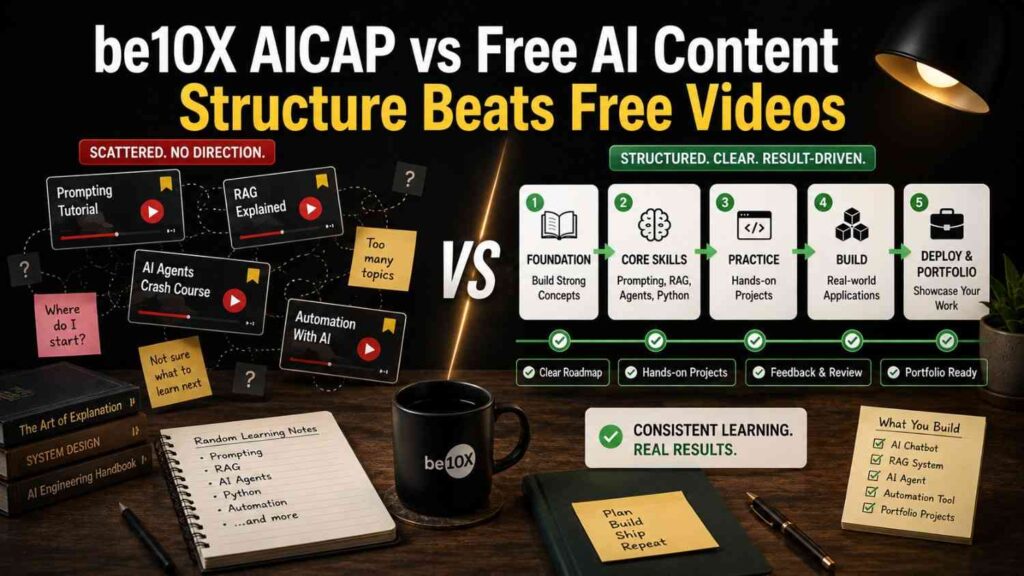
Free AI content has won the content argument outright, and any honest comparison of AI courses has to start by admitting it. Prompt engineering, agents, RAG, Power BI, Python, automation, all of it sits on YouTube and free platforms in better quality than most paid courses managed three years ago. Anyone who says the material is locked behind a paywall is selling something. The question worth asking is different: why do so few people who bookmark that free material ever end up with anything to show for it.
The answer is not intelligence or discipline. It is that free AI content is organized by topic while capability is built by sequence. PwC’s AI Jobs Barometer, cited in a feature on how four in five professionals will need to work with AI, reports a wage premium of around 56 percent for roles demanding AI skills, which is a strong enough incentive that lack of motivation cannot be the explanation.
What free AI content genuinely covers
Credit where it is due. NPTEL carries AI courses taught by IIT faculty with a proctored exam at the end. Kaggle Learn ends in notebooks a learner has actually run. Andrew Ng’s non-technical course gives vocabulary and judgement in a few hours. be10X ranks these alongside paid options in its list of the top AI courses in India for students and freshers, and two of the five entries are free.
For a student with time and no deadline, that free AI content stack is genuinely enough. Nobody should pay for content they can get free and will actually finish.
The three things free AI content does not supply
Sequence is the first. Free material answers the question you searched for, not the question you should have searched for next, so self-taught learners tend to accumulate tool familiarity while skipping the unglamorous middle where things get difficult.
Review is the second. Nobody looks at the output. A learner who builds an automation with a subtle flaw will keep that flaw, because the video cannot tell them their version broke.
A deadline is the third, and it is the one that decides outcomes. A course with no date attached competes with work, family, and everything else, and it loses quietly rather than dramatically.
The stall point is always the same
Learning from free AI content usually ends in a state that feels like progress and produces nothing transferable. The learner can describe what RAG is, has watched an n8n build, and has no working artifact to open in front of an interviewer. be10X covers why that gap is decisive in its piece on why a certificate and a finished project answer different questions.
What AICAP adds on top of free content
This is the honest way to describe how AICAP differs from other AI courses, because it is not the syllabus. Almost any syllabus can be reconstructed from free AI content.
It runs live, on weekends, for three months, with attendance tracked and recordings that deliberately do not count towards it. That single rule converts intention into a calendar commitment. Phase 1 moves through fundamentals, product building, agents, career readiness, and strategy in a fixed order rather than a browsable one, and Phase 2 splits into five specialisation tracks so a marketer and a data analyst stop doing identical work.
The part that answers the review problem is the industrial projects, each auto-approved within 48 hours, closing on a capstone, with completions publishable to a showcase for portfolio visibility. Free AI content will teach a learner to build a RAG-powered support agent with Pinecone and OpenAI. It will not tell them theirs is wrong, and it will not sit there as a finished, dated, showable thing at the end.
Who should stay with the free route
Anyone exploring whether AI interests them at all, anyone heading towards machine learning research or model training, and anyone who has reliably finished a free course before should stay free. AICAP is aimed at working professionals who have started free material more than once and stopped, and who need the weekend blocked out by something other than willpower.
The comparison, then, is not paid content against free content, since the content is the same. It is structured completion against unstructured intention, and that is the axis a prospective learner should judge every option on. Anyone weighing up the best AI course on those terms can see how the phases and projects are arranged inside be10X’s AI Career Accelerator Program.
