
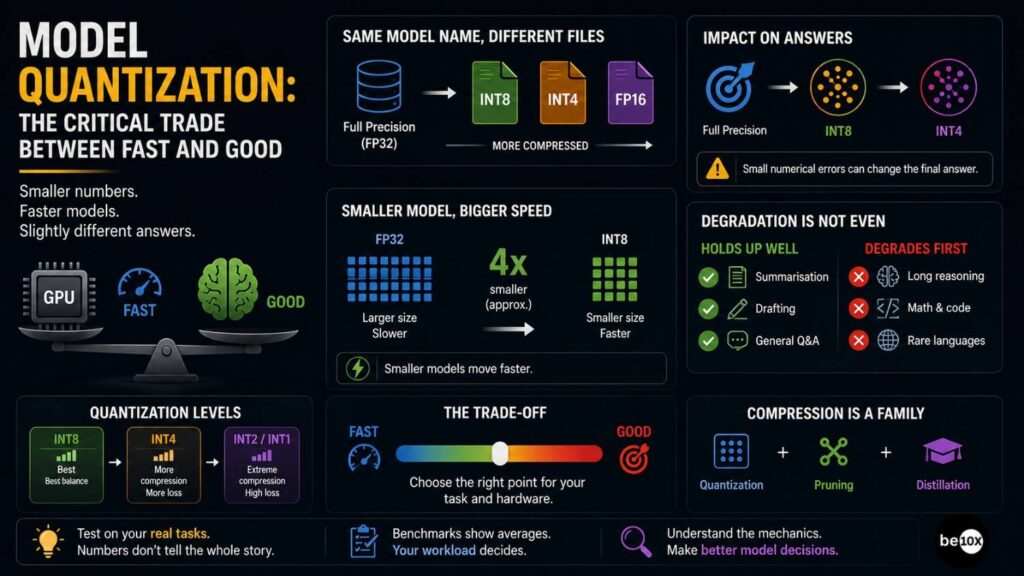
Model quantization is the reason two people can run what looks like the same model and get answers of noticeably different quality. One is running the full version on rented hardware. The other is running a compressed copy on a laptop, and the compression is not free.
The same model name can point at very different files
A model released under one name is usually available in several versions, and the differences are not in the training. They are in how precisely each number inside the model is stored. Model quantization is the process that produces those smaller versions, and the file that fits comfortably on a personal machine has almost always been through it.
Storing each number with fewer bits is the whole trick
A model is a very large collection of numbers. Each one is normally stored in a format that uses a fixed amount of space, and Hugging Face’s guide to lower-precision data types explains the effect of shrinking that format: an eight bit integer version is roughly four times smaller than the standard thirty two bit floating point original. Nothing is removed from the model. Every number is still there, just described more coarsely, the way a price rounded to the nearest hundred is still a price.
Memory is the bottleneck, which is why this works at all
Smaller numbers matter less for the arithmetic and more for the moving. Getting the model’s numbers from memory into the processor is usually what limits speed, so a version that occupies a quarter of the space moves through that pipe far faster. This is why model quantization produces gains that feel disproportionate to the change, and why a compressed model can respond quickly on hardware that could not load the original at all.
The answers change slightly, and slightly is doing real work
Model quantization introduces a small rounding error at every one of those numbers, and the errors accumulate through the layers. Most of the time the output is indistinguishable. Occasionally a token that would have been chosen by a narrow margin gets chosen differently, and from there the response diverges. Model quantization does not make a model dumber in any general sense. It widens the band of situations where the model’s second choice becomes its first.
The degradation is not spread evenly
This is the part that gets missed. Simple summarisation and straightforward drafting survive compression almost perfectly. Long chains of reasoning, arithmetic, code, rare terminology, and languages that were thinly represented in training degrade first, because those are the tasks where the margin between the right answer and a plausible wrong one was already thin. A model that passes a casual test can fail on precisely the work that mattered, which makes model quantization easy to approve and hard to evaluate.
Four bits is where the trade stops feeling free
Eight bit versions are close enough to the original that most professional use cases never notice. Cutting further, to four bits, buys another large reduction in size and starts to cost measurable accuracy, which is why serious four bit model quantization relies on more careful methods rather than plain rounding. The pattern holds generally: the first compression is nearly free, and each one after that is bought with something.
This is the hidden variable behind the local model decision
Be10X’s piece on why more builders are running models on their own machines names the constraint directly, listing GPU memory limits and quantization trade-offs among the realities of local deployment alongside cost, privacy, and control. The choice is rarely local versus hosted in the abstract. It is a specific compressed version of a model against a full one running elsewhere, and model quantization is what makes the former possible.
Compression is a family of techniques, not one setting
Reducing precision sits alongside other ways of making a model smaller, and Be10X covers that landscape in its comparison of small language models against large ones, which notes that quantization and pruning compress models by reducing the precision of their parameters, while distillation trains a smaller model on a larger one’s output. A small model and a compressed large model are different things that often get discussed as though they were the same.
The only honest check is the actual task
Benchmark tables on compressed versions describe average behaviour on a test set, which is not the same as behaviour on one specific workload. Running the real prompts through both versions and comparing takes an afternoon and settles the question properly. The AI Fundamentals module in be10x’s AI Career Accelerator Program covers this layer of model mechanics before any tool-specific content, because understanding why a model behaves the way it does is what turns a surprising output into a diagnosable one.
