
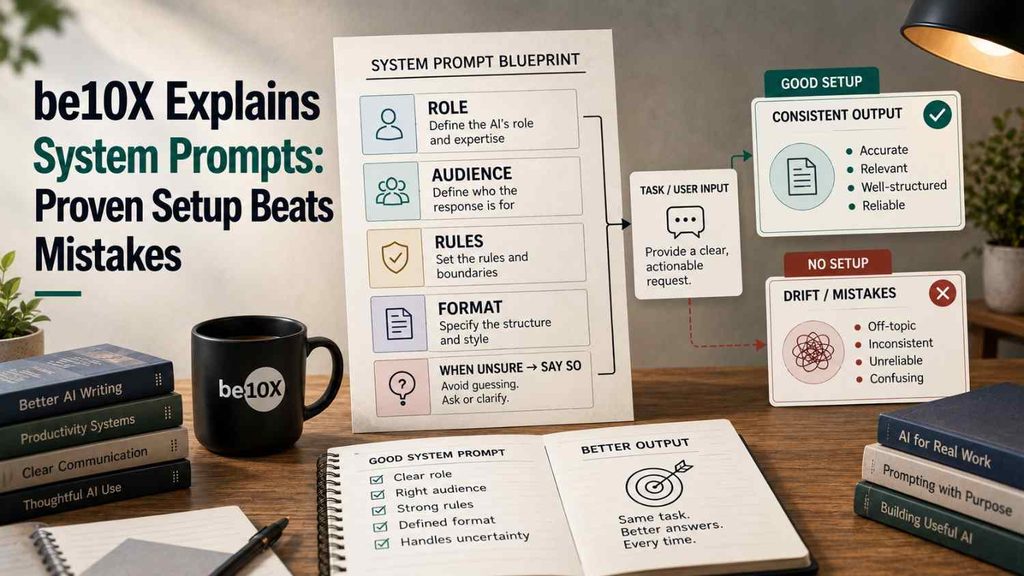
System prompts are the least glamorous part of working with AI and the part that decides how much of the rest works. Most professionals never touch one. They open a chat, describe who they are and what they need, get a decent answer, and then do the same thing again the next day with a slightly different description. The output quality swings without any obvious reason, and the swing is almost always traceable to what got said at the start rather than to the model.
The distinction matters more as AI moves from a novelty into the way work actually gets done. Coverage of AI execution as the next competitive advantage makes the same point at an organisational level, which is that the difference between teams is rarely tool access. It is whether anyone has set the thing up properly before asking it to perform.
What a system prompt actually is
Every conversation with a language model has two layers of instruction. The system prompt sits above the conversation and establishes standing context, which covers the role the model should occupy, the audience it is writing for, the constraints it must respect and the format it should return. The user message is the specific request. The model reads both, but it treats the standing layer as the frame and the request as the task inside that frame.
In practice this is the difference between opening with a paragraph explaining that the reader is a mid-market finance team, that numbers must never be invented, and that output belongs in a table, versus explaining all of that again inside every question. Both approaches can produce a good answer. Only one produces the same good answer on the fortieth question.
Why repetition costs more than it looks
Retyping context feels harmless because each retype is small. The cost of having no system prompt shows up in three quieter ways. Wording drifts, so the version typed on a busy afternoon is thinner than the careful version, and the output thins with it. Contradictions accumulate, because a request that says keep it brief sits alongside an earlier instruction to explain the reasoning, and the model resolves the conflict on its own. And the standing context competes with the actual question for the model’s attention, which is why buried requirements are the ones most often ignored.
None of this looks like a failure. It looks like the model being inconsistent, which is the conclusion most people reach.
What belongs in the setup layer
The useful test is whether an instruction would be true for every request in that workspace. Audience, tone, forbidden moves, output format, what to do when information is missing and how to handle uncertainty all pass that test and belong in the system prompt. Anything specific to one task, such as the actual data, the deadline or the particular question, does not.
The instruction most often missing is the one about not knowing. A setup layer that says to state plainly when the answer is not available in the material provided will prevent a large share of confident, useless output, and it takes one sentence.
A system prompt is not enforcement
Here is the limit worth understanding before anyone builds a workflow on top of one. A system prompt is a strong suggestion, not a hard rule. Under pressure from a long conversation, an unusual request or text pulled in from a document, the model can drift away from what the setup layer told it to do. be10X draws this line clearly in its piece on the difference between AI guardrails and instructions, and the practical takeaway is that anything which genuinely must not happen needs a check outside the model rather than a firmer sentence inside the prompt.
The related failure is the one that shows up in long threads, where instructions given at the start stop being followed somewhere in the middle. be10X explains the mechanism behind that in why an AI agent forgets your instructions, and the fix is usually restating the critical constraint rather than assuming the setup layer still holds.
Writing one that survives real work
A working system prompt is shorter than most people expect and more specific than most people write. Four or five sentences covering role, audience, hard constraints and output shape will outperform a page of aspirational description. The way to improve it is to keep the outputs that went wrong, find the instruction that was missing, and add that one line. A prompt built from actual failures beats one built from imagination every time.
The professionals who get consistent results from AI are rarely the ones with the cleverest single request. They are the ones who set the frame once and stopped renegotiating it. Anyone weighing up the best AI course for turning that habit into a working method will find prompt design treated as an engineering task rather than a list of tips inside be10X’s AI Career Accelerator Program, where learners build the setup layer for a real workflow and then break it on purpose.
